
Important tips
Important note: This white paper is only used to explain the technical architecture, economic model and governance mechanism of the GGD protocol. It is for information and educational purposes only. It does not constitute any investment advice, issuance offer or subscription invitation for securities or investment products, nor does it form the basis of any contract or commitment. There is a risk of fluctuation in the value of the token. Participants must make prudent decisions based on a full understanding of the rules of this agreement and related risks. This agreement does not actively promote or sell to retail investors; participants should confirm on their own that they are qualified to participate in relevant digital assets, RWA products or similar products in their jurisdiction. The protocol's on-chain access control (KYT/KYA and jurisdiction restrictions) is only used for address risk screening and restricted area blocking, and does not constitute verification of investor qualifications.
Summary
The GGD protocol is a decentralized ecosystem with gold as the value anchor. It connects physical gold with on-chain finance through the three-token collaboration model of GGT (gold RWA token), GGU (synthetic dollar unit), and GGD (governance token).
- Value anchors (GGT): 1 GGT = 0.001 ounces of gold. The underlying asset is currently Hong Kong-listed CSOP Gold ETF (3030.HK, tracking the gold fixing price of LBMA), and the number of directly held physical gold will be increased in the future. GGT is issued under the Master/Series DAO LLC structure in accordance with the laws of the Marshall Islands, with bankruptcy isolation, asset isolation and liquidation rights protection, and supports USDC/USDT free subscription and redemption and permissionless on-chain circulation;
- Fluctuation buffer (GGU): 1 GGU = 1 US dollar equivalent gold + gold hedging short order, the market neutral combination makes its US dollar value stabilize at 1 US dollars (non-stable currency); when staking, the daily market price is converted to GGT and multiplied by 0.9 The coefficient is included in the share;
- Governance Incentives (GGD): Total supply is fixed at 1,000,000,000 units, initial issuance on the network BNB Chain, 45% produced through staking mining; GGD unlocked in batches according to the cumulative minting amount (32,150,700 units per batch, approximately 1 tons of gold to unlock 95,000,000 units GGD), each batch 45,000,000 GGD injected into the ecological mining pool and released evenly over 730 days, daily release amount is calculated cumulatively when multiple batches are released in parallel; private placement of 50,000,000 units (5%) is not subject to batch unlocking restrictions; GGD carries the functions of governance voting, parameter adjustment, and ecological incentives.
- Node-based Mining: Anyone can apply to become a node (minimum stake 10,000 GGD). Users must stake through nodes (minimum 10 GGT). Third-party users can also participate in staking through nodes GGD and take part in voting. The base mining rate for individual users is 1.0. After staking GGD, the rate = 1 + the proportion of individual stake GGD to the total network stake GGD (no capped parameter, mathematically upper bound is 2.0). Node stake GGD exceeding the threshold generates a node base rate R_node (1.0 – 1.5), which multiplies the effective share for all users under that node. User output depends on both individual rate and the selected node rate (combined upper bound 3.0). Therefore, node selection directly affects mining output (see sections 7.5, 7.6 for details);
- Compliance and Transparency: BlockSec Phalcon KYT/KYA wallet screening, restricted jurisdiction IP blocking, periodic assurance reporting (T+5 Positions / T+45 Valuation), third-party contract security audits;
- Community co-governance: Core parameters such as rates, thresholds, and rates are all adjusted by GGD voting; DAO can vote to start the market repurchase replenishment pool after the mining pool is about to be exhausted or exhausted (the mining pool repurchase mechanism, the triggering point depends on the GGT casting progress, based on the annual average of approximately 1 tons, assuming approximately 11 end of the year) to ensure the continuation of mining incentives; after full circulation, the repurchase mechanism and market-oriented supply adjustment will be initiated (11.1 section GGD repurchase mechanism, based on the same assumption, approximately 11 year).
Key Parameters Overview: GGD Total Amount 1,000,000,000 · Initial Release BNB Chain · Node Threshold 10,000 GGD · Node Base Rate Upper Limit 1.5 (κ = 0.5) · Minimum Stake 10 GGT · GGT/GGU Only supports perpetual staking (can be unstaked at any time) · GGT Staking/Unstaking each 24 hours (user GGD staking has a separate 15-day lock-up, node GGD staking lock-up 90 days, unstaking arrives in 24 hours) · On-chain transfers are free of protocol fees (only network gas fees apply)
Part One Projects and Ecology
Chapter 1 Project Overview
1.1 Project background
As the most durable store of value in human history, gold has the characteristics of anti-inflation, risk aversion, and high global consensus. However, physical gold has natural limitations in circulation, division, custody and transaction efficiency. As the tokenization trend of blockchain technology and real-world assets (RWA, Real World Assets) matures, mapping gold assets to the chain has become an important path to connect the traditional precious metals market and decentralized finance (DeFi).
It is against this background that the GGD protocol was born: using the gold RWA token GGT as the value anchor, the synthetic value unit GGU as the fluctuation buffer layer, and the governance token GGD as the coordination center to build a gold financial ecosystem governed by the community and compatible with incentives.
1.2 Project Vision
GGD The protocol is committed to achieving three major goals:
- Value on-chain: Tokenize the holding rights and income rights of physical gold through GGT, reducing the threshold and friction cost of gold investment;
- Volatility governance: Alleviating the impact of gold and crypto market price fluctuations on ecological participants through the spot reserve and hedging mechanism of GGU;
- Community co-governance: Through GGD, democratic adjustment of protocol parameters is achieved, so that the direction of ecological development is jointly determined by currency holders.
1.3 Core design highlights
| Highlights | Description |
|---|---|
| Institutional grade gold asset base | GGT The bottom layer is currently Hong Kong listed physical gold ETF (CSOP Gold ETF, 3030.HK), tracking the LBMA gold fixing price, and the number of directly held physical gold will be increased in the future |
| Three-token collaboration model | GGT (value anchoring) / GGU (fluctuation buffer) / GGD (governance incentives) each performs its own duties and is coupled with each other |
| Node-based staking mining | Users must participate in staking through nodes, and the interests of nodes and users are deeply bound through the rate mechanism. |
| dynamic rate system | The user pledges GGD to increase the personal mining rate (1 + the proportion of personal pledges in the entire network, mathematical upper bound 2.0); the node pledge GGD generates the node base rate (1.0 – 1.5), which magnifies the effective share of its users by multiples. User income is determined by multi-dimensional factors. |
| Progressive supply release | GGD will be unlocked in batches with the cumulative minting amount of GGT, and the supply of governance coins and the scale of ecological gold reserves will expand simultaneously. |
| Institutional Level Legal Structure | Master/Series DAO LLC Structure, bankruptcy isolation, asset isolation and liquidation rights protection |
| Core parameters can be managed | Governance parameters such as pledge threshold, fee rate, and rate can be dynamically adjusted through DAO voting, while structural parameters remain constant (see section 15.2 for details) |
1.4 First network
GGD/GGT/GGU will launch on the network BNB Chain, taking full advantage of its low fees, high throughput and mature DeFi infrastructure. Subsequent cross-chain expansion plans will be voted on by DAO.
Chapter 2 Ecological Token System
GGD The protocol adopts a three-token structure. The three tokens respectively bear the functions of value anchoring, fluctuation buffering and governance incentives, forming a closed-loop economic system.
2.1 GGT (Global Gold Token) - Gold RWA Token
GGT is a permissionless (Permissionless) gold RWA token. Legal issuer: RWAfi DAO LLC - Series 2; issuance and technical service provider: AXC Labs; protocol layer parameters and contract control rights: vested in GGD DAO (see Chapters 3 and 4 for details on the underlying assets and legal structure, and section 12.2 for details on the issuance structure).
- Exchange rate: 1 GGT = 0.001 ounces of gold;
- Asset attributes: The bottom layer is currently CSOP Gold ETF listed in Hong Kong (3030.HK, holding LBMA standard physical gold bars). In the future, the directly held physical gold will be added to form a composite asset base;
- Two-way exchange: supports USDC/USDT subscription, casting and redemption, and gold can also be redeemed according to the agreement rules (the specific rate is subject to the actual situation, see Chapter 9 for details);
- Permissionless transfer: supports free transfers on the chain (P2P), and there is no transfer whitelist at the contract layer; no protocol handling fee is charged for on-chain transfers, and only the gas fee of the blockchain network is required (see section 9.1 for details); compliance screening is performed at the official front-end and the application and redemption channel and other protocol entrances (see section 5.1 for details), and tokens can be used externally DeFi Circulation portfolios in lending pools and other protocols;
- Issuance positioning: Unlicensed (Permissionless) gold RWA tokens, issued in accordance with the laws of the Marshall Islands; the issuance arrangement is structured with reference to the offshore issuance principles of the U.S. securities laws Regulation S, including not actively issuing or promoting to U.S. persons or the U.S. domestic market; such references should not be understood as the issuer’s confirmation that GGT necessarily does or does not qualify as a security in any jurisdiction.
2.2 GGU (Global Gold Unit) - Synthetic USD unit
GGU is a synthetic U.S. dollar unit collateralized by gold and hedged by delta: 1 GGU = 1 U.S. dollar equivalent gold + gold hedged short order. After gold long and short hedging, the net exposure to gold approaches zero, making its U.S. dollar value stabilize around 1 U.S. dollars. The value of GGU is anchored to the US dollar rather than gold (gold only serves as a mortgage and hedging carrier), and is not a legal currency reserve stablecoin 1:1. GGU assumes the role of a fluctuation buffer layer in the ecosystem: users can choose to pledge GGU instead of GGT to reduce the uncertainty caused by gold price fluctuations during the pledge period.
Basic rules
| elements | Description |
|---|---|
| Issuing entity | Issued by the GGD protocol smart contract, the contract control rights belong to GGD DAO |
| Value and composition | 1 GGU = 1 US dollar equivalent gold + gold hedging short order: When casting, the face value of GGU (1 US dollar) is converted into the 1 US dollar equivalent gold quantity, and the gold hedging short order is superimposed to hedge gold price fluctuations to form a market neutral combination, so that The USD value of GGU stabilizes around 1 USD (non-1:1 fiat reserve stablecoin) |
| pricing mechanism | The value of GGU US dollars has stabilized at 1 US dollars after hedging gold longs and gold short orders; both casting and redemption are performed based on the GGU face value (1 US dollars). When the application and redemption channel is normal, the oracle is normal, the market liquidity is sufficient, and there are no extreme market conditions, the application and redemption arbitrage mechanism may form certain constraints on the secondary market price (upper bound ≈ face value, lower bound ≈ face value minus redemption fee); however, this constraint is not a price commitment, nor does it guarantee any price lower limit. In extreme cases, the constraint may be completely ineffective. |
| Casting and Redemption | The subscription, casting and redemption of USDC/USDT is based on the face value of GGU (1 US dollars), and the specific rate is subject to the actual situation (see Chapter 9 for details); the secondary market price fluctuates around the face value of 1 US dollars, and the deviation is determined by 2.2.1 The festival mechanism is stable; specific pricing and settlement rules are subject to the on-chain contract. |
| Pledge conversion | GGU can be pledged to mine the governance coin GGD. The protocol will automatically convert it to the equivalent GGT according to the GGU market price every day, and will be multiplied by the 0.9 coefficient and included in the pledge share. |
The economic meaning of 0.9 coefficient: 0.9 is the fluctuation buffer discount coefficient. GGU The market price is determined by supply and demand, and there is a possibility of deviating from its 1 US dollar reference value; the discount is included in the pledge share, which is equivalent to reserving a safety margin of approximately 10% for the discounted valuation to cover the hedging costs of volatility suppression and the deviation risk under extreme market conditions. It should be noted that the corridor constraint on the price of subscription and redemption arbitrage is premised on the normal operation of the subscription and redemption channel - oracle circuit breaker (section 5.4) or in extreme market conditions, subscription and redemption may be suspended, the corridor may fail, and the price deviation may significantly exceed the normal corridor width, so the safety margin is reserved higher than the normal corridor width. It should be clear that the discount coefficient does not affect the secondary market price of GGU, but only affects the measurement of its share in pledge mining. This coefficient is not a fixed parameter - the protocol will be evaluated regularly based on hedging cost and market deviation data. If adjustments are needed, they must be approved by the DAO governance vote (see 15.2 section for parameter attributes).
2.2.1 GGU Fluctuation suppression mechanism
GGU uses 1 US dollar equivalent gold + gold to hedge short orders to build a market neutral exposure. The key points of the mechanism are as follows:
- Gold spot side: Each casting of 1 GGU corresponds to the long exposure of gold equivalent to 1 US dollars; the agreement treasury has a risk reserve account as the capital basis for hedging operations; the funds of the special account come from the regular accrual of agreement fee income, and the accrual ratio has a governance upper limit, and GGT underlying gold assets are not allowed to be used;
- Gold short order hedging end: In order to hedge gold price fluctuations, the agreement establishes a reverse position of gold short orders (spot short or derivatives short), so that gold long and short orders form a market-neutral combination, GGU The value of US dollars stabilizes at 1 US dollars; supplemented by the liquidity support of authorized market makers and the rebalancing of the liquidity pool; derivatives hedging is subject to DAO Governance votes to approve and disclose size caps and margin arrangements;
- Hedging ratio and initial exposure (truthfully disclosed): The short order margin comes from the regular accrual of the risk reserve account. The early fee income of the agreement is close to zero. When the reserves are insufficient GGU, complete hedging cannot be achieved in the early stage, and its US dollar value may deviate with the fluctuation of gold prices 1 US dollar; the agreement will gradually increase the hedging ratio as reserves accumulate, and perform hedging within the limit of existing reserves. It does not promise to fully hedge when it goes online, nor does it promise that the hedging ratio will reach any specific level; the actual exposure and hedging gap when reserves are insufficient will be disclosed to the community on a regular basis;
- Authority constraints: treasury operations must be signed by multiple signatures, and the execution team does not have the power to independently dispose of treasury assets; there is a ratio of a single-day hedging scale upper limit to a reserve usage upper limit, and operations exceeding the limit must be separately approved by DAO voting;
- Transparency: The treasury and reserve account addresses are publicly available on the chain, and the hedging operations and reserve scale are regularly disclosed to the community;
- Governance attributes: Parameters such as deviation trigger threshold, reserve accrual ratio, and single-day hedging scale upper limit can be adjusted through the DAO vote (see section 15.2 for details).
Hedge Execution and Responsibility Boundaries
The hedging operation is an off-chain execution behavior, which is separated from the on-chain issuance mechanism of GGU. Its responsibility boundaries are as follows:
| matters | arrange |
|---|---|
| Execution subject | The executor or service provider authorized by DAO governance shall execute according to the parameters and limits approved by governance, and multi-signature members shall be appointed, removed and replaced by voting by DAO |
| Profit and loss attribution | The profits and losses generated by hedging belong to the agreement treasury (risk reserve account), and participants do not enjoy any fixed income or capital protection rights. |
| executive responsibility | The executor only operates within the scope of authorization and does not make any commitment to the hedging effect; when the reserves are insufficient, execution can only be limited to the existing reserves, and the gap must be submitted to DAO for additional authorization or to accept price deviations |
| conflict of interest | Authorized market makers may be trading on their own in the market at the same time, resulting in potential conflicts of interest; their authorized quotas and quotation obligations are determined by governance and publicly disclosed |
Risk disclosure: The volatility suppression mechanism is designed to calm short-term price fluctuations. Spot reserves and hedging tools do not constitute any commitment or guarantee for the price of GGU. Under extreme market conditions, reserves may not be sufficient to fully hedge, and GGU prices may still fluctuate significantly (see Chapter 14 Risk Warning for details).
2.3 GGD (Global Gold DAO) - Governance Token
GGD is the governance token of the protocol and carries three major functions:
- Governance voting: vote on protocol parameter adjustment, vault use, protocol income disposal, contract upgrade, emergency suspension and other matters;
- Parameter adjustment: Governance parameters such as pledge threshold, fee level, mining rate formula parameters, etc. are all modified through GGD voting (structural parameters such as total amount, exchange ratio, unlocking trigger conditions, etc. are not within the scope of governance, see section 15.2 for details);
- Ecological incentives: as the output and reward carrier for activities such as staking mining and market incentives.
2.4 Three-token synergy relationship
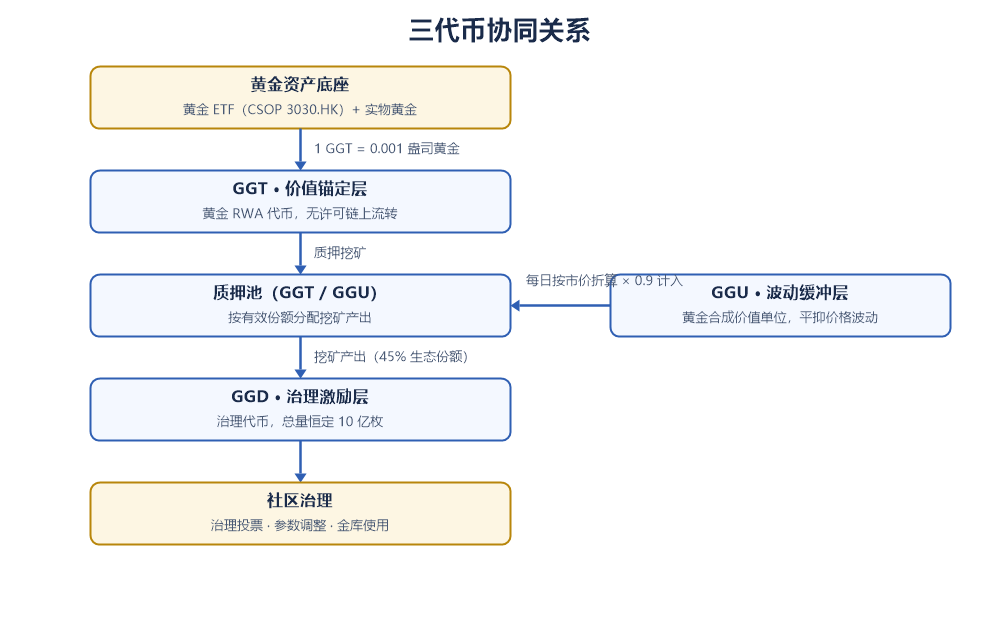
Figure 2-1: three-token synergy relationship
- GGT Provide a solid gold value base for the entire ecology;
- GGU establishes a fluctuation buffer zone between GGT and the user. GGT and GGU can be bidirectionally atomically converted at the reference price through the protocol interconversion channel (see section 9.2 for details);
- GGD is used to coordinate protocol governance and ecological incentives, and gradually transfer protocol control to community management.
Part 2 GGT: Gold Asset Layer
Chapter 3 GGT Underlying assets and product elements
3.1 Product positioning
Global Gold Token (GGT) is a real world asset (RWA) product designed to track the price of gold by investing in physically backed gold ETF. The legal issuers of GGT are RWAfi DAO LLC - Series 2 (see Chapter 4 for details), AXC Labs is its issuance and technical service provider, releasing on-chain liquidity and composability for the underlying gold assets; the protocol layer parameters and contract control rights belong to GGD DAO (for details on the issuance structure, see Chapter 12 12.2 section).
GGT The underlying assets adopt a phased evolution strategy: at the current stage, physical gold ETF (CSOP Gold ETF) is used as the underlying asset; in the future, directly held physical gold will be added as the underlying asset, and a composite asset structure of "gold ETF + physical gold bars" will be gradually constructed (see section 3.6 for details).
3.2 Underlying assets: CSOP Gold ETF (3030.HK)
| Project | Description |
|---|---|
| underlying fund | CSOP Gold ETF (CSOP Gold ETF), Hong Kong Stock Exchange code 3030.HK |
| Fund structure | A unit trust registered in Hong Kong and listed on the Stock Exchange of Hong Kong (SEHK) |
| physical standards | Holding physical gold bars of minimum 99.5% purity, sourced from refiners on the LBMA Good Delivery List (Good Delivery List) |
| Tracking Benchmarks | LBMA (London Bullion Market Association) Gold Price Morning Fixing (before fees) |
| fund manager | CSOP Asset Management Limited (CSOP Asset Management Co., Ltd.) |
The fund manager, Southern Dongying, is a leading ETF issuer in Asia. The scale of assets under management and the number of products are subject to the latest disclosure on the Southern Dongying official website (according to official disclosures, as of the end of 3 month in 2026, the scale of assets under management was approximately 32,300,000,000 USD).
3.3 Key elements at a glance
| elements | content |
|---|---|
| underlying asset fund | CSOP Gold ETF(3030.HK) |
| Fund entity | CSOP Asset Management Limited |
| deployment chain | BNB Chain |
| custodian | GoFintech Trust Limited (owned by GoFintech Quantum Innovation Limited, 00290.HK), holds the Hong Kong Securities and Futures Commission (SFC) No. 1, 4, 6, 9 Class license, and holds a Hong Kong trust or company service provider license (TCSP, TC 007765); the specific licensed legal person shall be subject to official disclosure |
| gold custodian | Primary custodian: The Hongkong and Shanghai Banking Corporation Limited; Deputy custodians: HKIA Precious Metals Depository Limited, Brink's Hong Kong Limited |
| gold dealer | Standard Chartered Bank, The Hongkong and Shanghai Banking Corporation Limited, Heraeus Metals Hong Kong Limited |
| Trustee and Registrar | HSBC Institutional Trust Services (Asia) Limited |
| Subscription method | ① Deposit for casting (primary market): USDC/USDT → GGT/GGU, minted according to the agreement reference price; ② Exchange Swap (secondary market/liquidity pool transaction): USDC/USDT ↔ GGT/GGU, transaction based on the real-time market price, there is no guarantee that the transaction price will be equal to the agreement reference price |
| transfer | Free transfer without permission (Permissionless Transferability); no protocol fees are charged for on-chain transfers, only the gas fee of the blockchain network where it is located (see section 9.1 for details) |
| Exit method | ① Redeem (primary market): GGT/GGU → USDC/USDT, settle and destroy tokens according to the agreement reference price; ② Exchange Swap (secondary market/liquidity pool transaction): GGT/GGU ↔ USDC/USDT, trade according to the real-time market price |
| Interchange channel | GGT ↔ GGU Atomic mutual transfer on the chain, GGT is converted according to the 5.4 section agreement reference price, GGU is converted at face value (1 US dollars), and the mutual transfer rate is set by DAO governance voting (see details 9.2 section) |
| base currency | USDC / USDT |
3.4 Performance and Tracking
- GGT seeks to track the performance of CSOP Gold ETF (HKEX: 3030), which is benchmarked to the LBMA Gold Morning Fix before fees;
- The performance and tracking difference information between LBMA gold fixed price and CSOP Gold ETF can be queried on the CSOP official website (https://www.csopasset.com);
- The token issuer will use reasonable efforts to minimize tracking differences between GGT and CSOP Gold ETF, but tracking differences may still occur and the risk is borne by the token holder;
- The real-time liquidity framework and real-time price oracles may cause the token price to deviate from the underlying asset price.
3.5 Supervision Qualification
- GGT is a permissionless (Permissionless) RWA token that allows users to make permissionless P2P transfers (there is no protocol fee for on-chain transfers, only the gas fee of the blockchain network where it is located is required, see section 9.1 for details), and can be used externally DeFi Circulated in lending pools and other protocols;
- GGT is a RWA token issued in accordance with the laws of the Republic of the Marshall Islands; the issuance arrangement is structured with reference to the offshore issuance principles of the U.S. Securities Act Regulation S, including not actively issuing or promoting to U.S. persons or the U.S. domestic market; such references should not be construed as the issuer’s confirmation that GGT necessarily does or does not qualify as a security in any jurisdiction;
- According to the structural design of the issuer's current legal counsel, GGT is intended to be issued as a linked digital asset that tracks the performance of the underlying gold assets, providing holders with economic exposure to track the performance of the underlying assets; the regulatory characterization of such arrangements may differ in different jurisdictions, and GGT may be regarded as securities, collective investment schemes, derivatives, structured products or other regulated products in some jurisdictions. Participants should consult their own professional legal, tax and financial advisors;
- The product can accept qualified wallet addresses, smart contract addresses, natural persons or legal entities to participate through official agreements as USDT/USDC, provided that they meet applicable laws, agreement rules and compliance screening requirements; and implement KYT/KYA address risk screening, AML risk control and jurisdiction restrictions on the official front-end and redemption channels (see Chapter 5 for details).
3.6 Evolution of underlying assets: from gold ETF to "ETF + physical gold"
The underlying asset structure of GGT will evolve in two stages:
Phase One (Current): Physical Gold ETF
- The underlying assets are CSOP Gold ETF (3030.HK), which indirectly obtains physical gold exposure by holding fund shares;
- This stage relies on ETF’s mature liquidity, custody and auditing systems to achieve rapid issuance and institutional-level compliance.
Phase 2 (Planning): Increase direct holdings of physical gold
- On the basis of gold ETF, physical gold bars (LBMA qualified delivery standard) directly held by the custody institution are added as the underlying assets;
- Gradually form a composite asset base of "gold ETF + physical gold bars" to reduce dependence on a single fund product and enhance the directness and redundancy of asset holdings;
- The custody arrangement, matching target and switching schedule of physical gold will be decided by DAO governance voting and announced to the community in advance;
- The adjustment of the underlying asset structure will not change the exchange ratio of 1 GGT = 0.001 ounces of gold, nor will it change the existing rights of the holders.
No matter which stage it is at, the underlying assets of GGT are based on the LBMA standard as the quality benchmark and accept regular assurance reports and audit supervision (see Chapter 5 for details).
3.7 GGT Redemption Golden Rules
GGT holders can redeem GGT into physical gold according to the agreement rules. Redemption of gold follows the following rules:
3.7.1 Minimum redemption amount
- The minimum amount of gold to be redeemed in a single transaction is 50,000 GGT (corresponding to 50 ounces of gold);
- The minimum redemption amount can be adjusted by the DAO governance vote.
3.7.2 Delivery method and address
| Delivery method | Description |
|---|---|
| Self-pickup from the vault | The applicant goes to the designated delivery vault to withdraw physical gold. The vault address is the designated LBMA standard vault in Hong Kong (kept by the gold custodian: The Hongkong and Shanghai Banking Corporation as the main custodian, and the deputy custodians HKIA Precious Metals Depository, Brink's). The specific address will be provided after the redemption application is approved. |
| insured transportation | The insurance logistics service provider that cooperates through the agreement will transport the physical gold to the applicant's designated address (only in jurisdictions that allow precious metal delivery), and the transportation and insurance costs will be borne by the applicant. |
3.7.3 Redemption Process
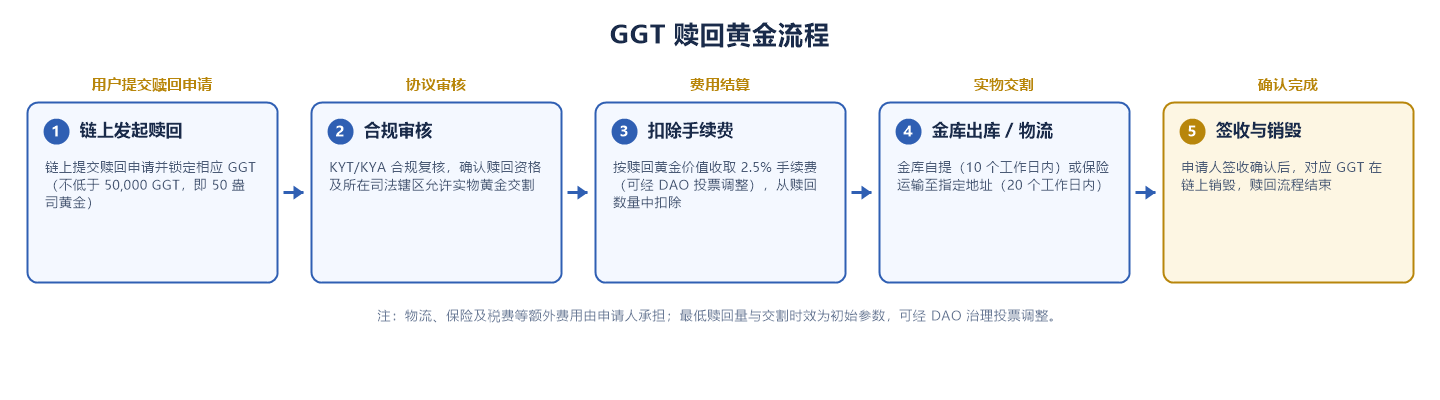
Figure 3-1: GGT gold redemption process
- Initiate an application: The holder submits an application to redeem gold on the chain and locks the corresponding amount of GGT (not less than the minimum redemption amount);
- Compliance review: The agreement conducts a review of the applicant's address KYT/KYA to confirm that it meets the redemption conditions and that the jurisdiction in which it is located allows physical gold delivery;
- Fee settlement: Handling fee is charged according to the value of the gold redeemed (the specific rate is subject to the actual situation and can be adjusted by voting by DAO), which will be deducted from the redemption amount or paid separately by the applicant in USDC/USDT;
- Physical delivery: The agreement coordinates the custodian's delivery of the corresponding weight of LBMA standard physical gold from the vault, and completes the delivery according to the delivery method selected by the applicant (self-pickup or insured transportation). Physical gold delivery is affected by gold bar specifications, minimum delivery units and custody arrangements; if there is a fractional ounce difference, it can be settled at USDC/USDT according to the agreed reference price;
- Confirmation of completion: After the custodian/logistics service provider issues a valid delivery certificate, the applicant completes the signature, or the delivery is deemed completed according to the redemption agreement, the corresponding GGT is destroyed on the chain and the redemption process ends.
3.7.4 Redemption time limit
- From the date the application is approved, the physical gold delivery is expected to be completed within 10 working days (self-pickup from the vault) or 20 working days (insured transportation, depending on the destination);
- In the event of force majeure or extreme market conditions, the delivery deadline may be extended, and the agreement will be notified to the applicant in a timely manner.
The above-mentioned minimum redemption amount, delivery time limit, etc. are initial parameters and can be adjusted through DAO governance voting. Additional costs such as logistics, insurance and taxes involved in redeeming gold shall be borne by the applicant.
Chapter 4 GGT Legal Structure and User Rights
4.1 Overview of Legal Structure
The legal structure of GGT aims to achieve the following goals: allow non-permissioned token holders to indirectly obtain economic exposure to the underlying asset returns and obtain asset value distribution in the event of liquidation; while providing institutional-level bankruptcy isolation, asset isolation and liquidation rights protection, and minimizing regulatory friction.
4.2 Master/Series DAO LLC structure
In order to achieve transferability, financial privacy and regulatory compliance, the agreement adopts the Master/Series DAO LLC (Master/Series DAO Limited Liability Company) structure: the underlying asset share is purchased from the asset manager and is beneficially held by a specific Series DAO LLC, which Series DAO LLC is affiliated with Master DAO LLC.
Take GGT as an example:
- Master DAO: RWAfi DAO LLC (a Marshall Islands non-profit entity, filed as a single member), is the parent legal entity in the GGT issuance structure;
- Series DAO: RWAfi DAO LLC - Series 2, the legal issuer of GGT, beneficially holds the underlying assets (currently CSOP Gold ETF share, and will increase the direct holding of physical gold according to the evolution of 3.6);
- AXC: As the issuance and technical service provider of GGT, we charge management fees for the operation of token-related platforms.
| Participants | Place of registration | role |
|---|---|---|
| Master/Series DAO LLC (RWAfi DAO LLC / RWAfi DAO LLC - Series 2) | Marshall Islands | Master Establish each Series LLC to hold assets and establish a direct relationship with the custodian; Series beneficially owns the underlying assets |
| Blockchain service provider (AXC) | cayman islands | Provide technical support for token issuance and management, and charge management fees |
| underlying asset manager | many places | Asset Management (CSOP Asset Management) |
| custodian | Hong Kong | Hold cash and underlying assets on behalf of the token issuer in a trust relationship |
4.3 Legal Agreement Framework
The relationship between entities, service providers and token holders of permissionless tokens is governed by the following legal contract framework:
| contract | Parties | Description |
|---|---|---|
| Terms and Conditions (Terms and Conditions) | Holder with Series LLC | Standardizes the main obligations of holders: non-custodial structure, tokens do not represent LLC or underlying asset equity/ownership; list jurisdictional transfer restrictions; disputes shall be governed by Marshall Islands law, HKIAC arbitration |
| Investor Addendum (Investor Schedule) | Holder with Series LLC | Supplementary document to "Terms and Conditions", specifying investor rights arrangements such as liquidation and distribution |
| Token Memo (Token Memorandum) | Holder with Series LLC | Detailed description of BEP-20 (ERC-20 compatible) token mechanism: holders participate indirectly through the issuer holding fund shares; prompts tracking errors and market and underlying asset risks |
| Escrow/Ownership Contract (Custody/Ownership Contract) | Master LLC and Series LLC | Allow Master LLC to act on behalf of Series LLC; all series of assets are beneficially owned by a specific Series (nominally registered in the name of Master LLC), achieving asset isolation |
| Blockchain Service Contract (Blockchain Services Contract) | Series LLC and AXC | Non-trustee, non-exclusive appointment of token service provider; flexible fee mechanism; strict limitation of liability except for negligence or fraud; HKIAC Arbitration (Marshall Islands/Delaware Reference Law) |
| Escrow Account Agreement (Custodial Account Agreement) | Master LLC with the custodian | Establishing a securities account for Hong Kong institutional/professional investors; including product risk disclosure; granting account rights required for compliance to licensed brokers AML/KYC |
4.4 Structural Protection and Risk Mitigation
4.4.1 Special Purpose Vector (SPV) Structure
GGT The underlying assets are segregated to the independent Marshall Islands Series LLC (RWAfi DAO LLC - Series 2). The SPV only holds the underlying assets of GGT and does not hold any external contracts except those with token holders, custodians and necessary service providers. In order to minimize the legal risk in various jurisdictions regarding the recognition of the master/series structure, this series of positions only implements long strategies (long-only).
4.4.2 Bankruptcy segregation and asset segregation
The legal structure is clearly designed to achieve bankruptcy insularity:
- Service provider isolation: SPV and AXC (blockchain service provider) are legally independent from each other, and the claims against AXC will not extend to the assets held in SPV;
- Cross Liability Protection: GGT The Fund maintains a separate balance sheet in accordance with Marshall Islands law. Since the fund executes a long-only strategy, token holders’ potential claims will not exceed the available assets of the series. If other series of funds are expanded in the future and strategies that may generate excess liabilities are adopted, a completely independent Master DAO LLC will be established to prevent cross-jurisdictional non-recognition risks;
- Custody Segregation: Beneficial ownership of all assets vests SPV. The custodian is a licensed trust institution, ensuring that SPV assets and the custodian’s own assets are legally isolated from each other.
4.4.3 Liquidation Rights
Although tokens do not grant holders direct equity or voting rights in the underlying fund, the "Terms and Conditions" and the "Investor Addendum" both stipulate that: To the extent permitted by applicable laws, relevant contract documents, liquidation procedures, taxes and creditor's rights settlement sequence, token holders may, in accordance with relevant contractual arrangements, receive SPV according to their holding shares in the liquidation of SPV Distribution of remaining assets (subject to liquidation costs, custody costs, outstanding debts and taxes, and subject to legal proceedings, cross-border enforcement and restricted jurisdiction restrictions). This right arises from a contractual arrangement and does not constitute a claim to equity or membership interests in SPV. The specific remedies available to holders in the event of liquidation are determined by cross-jurisdictional case law. Please consult a legal professional for specific circumstances.
4.5 User Rights
- Eligibility to participate: Users can be natural persons, legal entities or on-chain wallet addresses (including externally owned accounts and smart contract wallets), and are all eligible to participate in the unlicensed products of the GGD protocol;
- Access requirements: Token holders do not need to complete AML/KYC or wallet address whitelist registration; KYT/KYA compliance checks are performed at the official front-end and the agreement entrance such as the redemption channel (see Chapter 5 for details). The transfer of P2P on the chain is open, and holders must abide by the transfer restrictions and applicable laws in the "Terms and Conditions";
- Legal relationship: The legal relationship between the token holder and the issuer is governed by the "Terms and Conditions" and applicable laws, and legal recourse is limited; there is no trust, fiduciary or beneficial ownership relationship between the user and the token issuer, and what the user obtains is indirect economic exposure to the performance of the underlying assets;
- Issuer commitment: The token issuer promises to deploy funds in designated underlying investments;
- Rights arrangement: Token holders may receive allocation of underlying assets in proportion to their shares upon liquidation. These arrangements are similar in economic effect to the status of structured product investors or fund limited partners, but do not constitute partnership interests, fund shares or securities holdings in the legal sense; token issuers are still subject to applicable anti-fraud and anti-fraud laws;
- Transfer and redemption: There are no protocol-level whitelist restrictions on token transfer on the chain, but holders must abide by the jurisdiction transfer restrictions and applicable laws in the "Terms and Conditions" (users in restricted jurisdictions are prohibited from participating, see section 5.1 for details); holders do not have legal redemption rights against the issuer - subscription and redemption (including redemption of gold, redemption USDC/USDT) is a contractual arrangement provided by the issuer in accordance with the "Terms and Conditions" and must meet the corresponding conditions and rates (the rates are subject to actual conditions, see section 3.7 and Chapter 9 for details); users exchange tokens by depositing and withdrawing cryptocurrency.
Chapter 5 Compliance, Transparency and Security Audit
5.1 KYC/AML Policy
5.1.1 Partner channel access
For users who access products through third-party distribution channels, AXC Labs relies on licensed partners and other KYB audited distribution partners (such as neobanks neobank and regulated exchanges) to ensure regulatory compliance. These partners are responsible for enforcing end-user KYC/AML policies in accordance with their respective jurisdictions and licensing requirements.
5.1.2 direct access (via AXC Labs)
For users who interact directly with the GGD protocol, AXC Labs ensures compliance through a robust, principles-based internal review process, including:
- Wallet screening (KYT and KYA): In the official front-end and protocol entrances such as redemption channels, user wallets must pass the KYT (Know Your Transaction) and KYA (Know Your Address) checks supported by the BlockSec Phalcon compliance suite, including based on OFAC The sanctions list and global risk database conduct real-time screening of wallet addresses and transactions, filter high-risk entities and mark suspicious fund flows; there is no transfer whitelist at the contract layer on the chain, and P2P the compliance obligations for transfers are borne by the holders themselves;
- Jurisdictional Restrictions: Users located in the United States, mainland China, or any jurisdiction currently under United Nations sanctions are strictly prohibited from interacting with the GGD protocol. To proactively enforce this policy, the GGD protocol has implemented a IP geo-blocking of all restricted areas;
- Description of the nature of screening: Protocol layer KYT/KYA screening and IP geographical restrictions are only used for address risk screening and restricted area blocking, and are not equivalent to KYC, investor suitability assessment or qualified investor certification in the traditional financial context;
- Description of restriction effect: Although the protocol adopts measures such as IP geographical blocking, address risk screening and distribution channel restrictions, the openness of assets on the chain may cause users in restricted areas to pass through unofficial channels (VPN, DEX, P2P Transfers, third-party contract interaction, etc.) contact or hold tokens; such users are not allowed to participate in agreement redemption, pledge or governance, and shall bear the legal consequences arising therefrom.
5.2 Reporting and Transparency
In order for token holders to obtain the information they need to make decisions, token issuers provide holders with regular assurance reports (Attestation Report) on the assets they hold, including:
- Number of issued tokens;
- assets held by the issuer;
- Valuation of assets held.
Supplementary documents include:
- Underlying fund prospectus (Prospectus);
- Confirmation of trust beneficial interests;
- Subscription confirmation issued by a third-party administrator.
Report information sources are divided into on-chain and off-chain: on-chain information can be read instantly from the blockchain; off-chain sources need to rely on third parties, and their supporting documents will be provided to token holders. The information on the assets held by the issuer is provided by the custodian and can be provided within T+5 working days after the subscription and redemption date; the processing of off-chain asset valuation information is longer and may be delayed to T+45 working days.
5.3 Smart Contracts and Security Audit
- GGT The relevant smart contract has completed a third-party security audit, and the relevant audit report will be disclosed through official channels; the specific audit agency, audit time and report number shall be subject to official disclosure;
- GGD The audit report of the protocol contract will be announced through official channels when the mainnet goes online;
- In an emergency, DAO can trigger the contract emergency suspension mechanism through the governance process (see Chapter 10 for details).
5.4 Price oracle and exception handling mechanism
The price data of the agreement (GGU market price conversion, GGT reference pricing, etc.) relies on the on-chain oracle. Terminology distinction: GGU has a face value fixed at 1 US dollars and is used for the settlement of primary market redemptions and GGT↔GGU mutual transfers; GGU market price is aggregated by multi-source oracles and used for the conversion and calculation of pledged shares. The mechanism framework is as follows:
| elements | Mechanism design |
|---|---|
| Oracle type | Using decentralized multi-source oracles, the data source consists of multiple independent oracle networks and mainstream exchange price aggregation to avoid single points of failure and single data source manipulation. |
| How to get price | After eliminating deviations from the multi-source prices, the median is taken as the reference price for settlement and conversion of the agreement. |
| Abnormal fuse | When the multi-source price deviation exceeds the set threshold, or the oracle data has not been updated for a long time, the relevant conversion and settlement functions will be automatically suspended and a governance alarm will be triggered. |
| recovery mechanism | The function can be restored only after the price source returns to normal or is confirmed by DAO governance |
| Governance attributes | Parameters such as data source collection, deviation threshold, pause duration, etc. can be adjusted through DAO voting |
During the oracle abnormality, the user's pledged shares will not be affected, only the conversion and settlement operations that rely on real-time prices will be suspended.
Arrangements for parameter announcement: Specific oracle data sources (oracle network selection, exchange data source collection, GGU price pool), deviation thresholds, data expiration determination time, price frequency and exception handling parameters will be announced as genesis parameters before the mainnet goes online, and can be adjusted by DAO governance (see section 15.2 for details).
Part 3 GGD: Protocols and Governance Layers
Chapter 6 GGD Token Economic Model
6.1 Total amount and issuance
- Token name: Global Gold DAO (GGD)
- Total token supply: 1,000,000,000 tokens (1,000,000,000 tokens), total supply is fixed
- First network: BNB Chain
- Issuing entity: GGD is issued by the GGD protocol smart contract, and the contract control rights belong to GGD DAO
6.2 Token distribution
| Distribution direction | Proportion | Quantity (pieces) | Description |
|---|---|---|---|
| Ecological mining | 45% | 450,000,000 | On-chain staking GGT/GGU mining GGD. The total amount of ecological mining is 450,000,000 coins. This amount is not released all at once when the protocol starts, but is injected into the corresponding release batch with each batch of 95,000,000 coins unlocked at GGD, distributed linearly over 730 days (see 8.4.5 sections); once the mining pool is about to be exhausted or is exhausted, it can be supplemented by DAO voting (see 11.3 section). |
| market incentives | 15% | 150,000,000 | Used for marketing, liquidity incentives, and ecological activity rewards. With each batch of 95,000,000 coins unlocked at GGD, 15,000,000 coins per batch are injected into the market incentive pool. |
| DAO Foundation | 15% | 150,000,000 | Managed by DAO treasury for the long-term ecological development. With each batch of 95,000,000 coins unlocked at GGD, 15,000,000 coins per batch are injected into the DAO foundation pool. |
| core team | 20% | 200,000,000 | Core Team Incentives. With each batch of 95,000,000 tokens, GGD tokens are unlocked and injected into the core team pool per batch of 20,000,000 tokens. |
| private placement | 5% | 50,000,000 | Early stage institutional and strategic investors. Not subject to batch unlocking restrictions and will not be unlocked with batches |
| total | 100% | 1,000,000,000 | — |
6.3 Batch unlocking mechanism
In order to avoid the rapid release of governance currency supply from impacting the market, GGD adopts a batch unlocking mechanism linked to the scale of ecological gold reserves:
- Initial Unlock: The first batch of 95,000,000 tokens is unlocked when the protocol launches GGD;
- Triggered Unlock: When the cumulative minting of GGT reaches 32,150,700 tokens (corresponding to approximately 1 tons of gold reserves), the next 95,000,000 tokens GGD is unlocked.
- Cyclic Progression: By analogy, for every additional approximately 1 tons of GGT casting scale, a batch of GGD (95,000,000 pieces/batch) is unlocked, until all 10 batches, totaling 950,000,000 pieces, are fully unlocked;
- Private placements are not subject to batch unlocking restrictions: Private placement shares 50,000,000 pieces (5%) are not subject to batch unlocking restrictions (that is, they are not unlocked based on the cumulative casting volume of GGT and do not follow batch release); 950,000,000 pieces (batch unlocking) + 50,000,000 pieces (private placement, not subject to batch restrictions) = 1,000,000,000 pieces total.
Unlocking process instructions:
| batch | GGD Unlocked amount | Trigger condition | Corresponding to the size of gold reserves |
|---|---|---|---|
| Private placement (not subject to tranche restrictions) | 50,000,000 pieces | —(not subject to batch unlocking restrictions) | — |
| first batch | 95,000,000 pieces | Protocol start | — |
| second batch | 95,000,000 pieces | The cumulative casting amount is full 32,150,700 pieces | Approximately 1 tons |
| The third batch | 95,000,000 pieces | The cumulative casting amount is full 64,301,400 pieces | Approximately 2 tons |
| … | … | … | … |
| The tenth batch | 95,000,000 pieces | The cumulative casting amount is full 289,356,300 pieces | Approximately 9 tons |
This mechanism ensures that the supply expansion of GGD is always based on the growth of ecologically real gold assets and achieves the dynamic matching of "governance currency supply - asset reserves - ecological scale".
Trigger caliber description: The unlocking trigger is based on the cumulative casting amount of GGT (i.e., the historical total casting amount of GGT, including the casting generated by the primary market subscription casting and GGT↔GGU mutual transfer), rather than the net circulation. Triggering is irreversible - even if GGT is subsequently redeemed and destroyed, and the net circulation drops, the unlocked batches will not be rolled back. This caliber is chosen to avoid fluctuations in circulation causing repeated unlocking states. It should be noted that the GGU→GGT direction casting of the GGT↔GGU mutual transfer channel is also included in the cumulative casting amount (see section 9.2 for details), which objectively provides the possibility to increase the cumulative casting amount through cyclic transfer; this risk has been truthfully disclosed in the 14.1 section. For the unlocking behavior of "casting→redemption→recasting", the redemption must pay a redemption fee (the rate is subject to the actual situation). If you complete an unlocking batch (32,150,700 pieces GGT), you must bear the huge amount of funds occupied and the corresponding rate cost; see the 14.1 section for details on the relevant residual risks.
Batch Allocation: For each batch, out of the 95,000,000 GGD unlocked, 45,000,000 will be injected into the ecological mining pool (corresponding to a total of 45% shares), 15,000,000 will be injected into the market incentive pool (15%), 15,000,000 will be injected into the DAO foundation pool (15%), and 20,000,000 will be injected into the core team pool (20%). The private placement of 50,000,000 (5%) is not subject to batch unlock restrictions and does not unlock along with the batches. The shares of the core team and private placement have independent lock-up and linear vesting (vesting) arrangements. The default framework is: both the core team and private placement have 6 months Cliff (lock-up period) + 18 months of linear release (for the core team, counted from the batch unlock; for private placement, the vesting start date is based on the on-chain contract); final parameters are subject to the on-chain contract, can be adjusted by DAO voting, and are subject to the supervision of DAO.
Chapter 7 Node System
The node is the pledge channel and service infrastructure of the GGD protocol pledge mining network, responsible for user pledge aggregation, forwarding, governance participation support and service fee settlement functions.
7.1 Access Principles
- Open access: Anyone can apply to become a node, no permission is required;
- Threshold pledge: The minimum initial pledge required is 10,000 GGD;
- Node basic rate: The part of the node pledge GGD that exceeds the threshold will generate the node basic rate R_node according to the rules, which will be used as a multiple to amplify the effective pledge share of all users under the node (see the 7.5 section for details on the formula and upper limit);
- Third-party participation: Third-party users can pledge GGD through any node and participate in governance voting, and their pledge amount will be included in the personal mining rate (see section 7.2 for details);
- Dynamic adjustment: The minimum pledge amount can be adjusted later through the DAO vote.
7.2 User GGD Staking and Personal Mining Rate
The mining rate is a personal attribute of the user, determined by the amount of GGD pledged by the user: the rate when unpledged GGD is the basic value 1.0; the post-pledge rate increases with the proportion of the personal pledge amount to the total GGD pledge in the entire network. The more pledges and the larger the proportion, the higher the rate.
7.2.1 Rate definition and formula
R_user = 1 + S_GGD_user ÷ S_GGD_total
- R_user: User’s personal mining rate coefficient (when GGD is not pledged, R_user = 1.0);
- S_GGD_user: The amount of GGD currently pledged by the user (including the part pledged through the node, ≥ 0);
- S_GGD_total: The total amount of GGD pledged by all users in the entire network (including threshold pledges of each node and third-party pledges, that is, the sum of user pledges and node pledges).
Stratification principle: The GGD pledged by the user only enters the personal rate R_user, and the GGD pledged by the node (including the threshold and excess part) only enters the node base rate R_node (7.5 section). The two do not repeat profit calculations to avoid double obtaining rate gains for the same GGD. It should be noted that node staking is also included in the denominator of S_GGD_total, so an increase in node staking scale will dilute the R_user of all users (see section 14.1 for details).
7.2.2 Rate Example
Taking the total network GGD pledge amount of 5,000,000 tokens as an example:
| User pledge GGD quantity | Proportion of the entire network | Personal Rate R_user |
|---|---|---|
| 0 (unstaking) | 0% | 1.00 |
| 50,000 | 1% | 1.01 |
| 100,000 | 2% | 1.02 |
| 250,000 | 5% | 1.05 |
| 500,000 | 10% | 1.10 |
| 1,000,000 | 20% | 1.20 |
| 2,500,000 | 50% | 1.50 |
Note: The above table is an example, and the actual rate changes dynamically with the total amount of GGD pledged in the entire network. When the total amount of pledges in the entire network increases, the proportion of existing pledgers is diluted and the rate naturally drops; otherwise, it increases.
7.2.3 Game characteristics
- Basic fairness: The rate of users who have not pledged GGD is always 1.0, there is no threshold premium, and all users stand on the same starting line;
- Linear transparency: The rate increment is strictly linearly positively correlated with the proportion of personal pledges in the entire network. The rules are transparent and can be verified in real time;
- Rate competition: The increase in the proportion of any user is the relative dilution of the proportion of other users, forming rate competition among users to encourage long-term holding and continuous staking GGD;
- Dynamic rebalancing: When the total amount of pledges in the entire network increases, the proportion of existing pledgers is diluted and the rate naturally drops; otherwise, it increases, and the rate is rebalanced in real time with the pledge pattern of the entire network.
7.2.4 Mathematical properties
- Boundedness: The formula does not contain capping parameters, and there is a mathematical upper bound on the rate 2.0: when S_GGD_user < S_GGD_total, 1.0 ≤ R_user < 2.0; only when a user is the only GGD pledger in the entire network (S_GGD_user = S_GGD_total), R_user is exactly equal to 2.0. Boundary situation: When the protocol is initially started S_GGD_total = 0, all user rates are calculated based on the basic value 1.0. Also note: If a single address holds and pledges the vast majority of GGD, although its rate is subject to a mathematical upper bound, the income distribution will still be highly concentrated, and there is a risk of governance concentration (see Chapter 14 Risk Warning for details);
- Monotonicity: R_user is strictly monotonically increasing on S_GGD_user. The pledge amount of other users in the entire network S_GGD_other = S_GGD_total − S_GGD_user is regarded as an exogenous quantity when the user makes a decision, then ∂R_user ÷ ∂S_GGD_user = S_GGD_other ÷ S_GGD_total² > 0 (when S_GGD_user < S_GGD_total), the more pledges, the higher the rate;
- Marginal decrease: The absolute rate gain of unit GGD is S_GGD_other ÷ S_GGD_total² (non-constant 1 ÷ S_GGD_total, only when its own proportion tends to 0 (approximately true), and decreases as the amount of pledges increases; the relative increase (ΔR ÷ R) also continues to decrease as the amount of pledges increases, and the greater the total amount of pledges in the entire network, the smaller the gain for the same amount of pledges, forming a natural diminishing marginal margin;
- Zero-sum: The sum of the rate increments of all staking users in the entire network Σ(R_i − 1) = Σ(S_i ÷ S_GGD_total) = 1, the total amount of rate increment allocation is constant; no new output is added at the node layer (R_node), and the share of each node subnet is only redistributed according to multiples. After superposition, the sum of the gross output of the entire network users is still equal to E_day (for details on conservation, see section 8.4.3).
Important note: Rate competition only affects the distribution ratio of mining output among users, and does not change the total amount released by the entire network mining pool - E_day is determined by the release curve of the unlocked batch (see sections 8.4.5 for details), and has nothing to do with the rate. An increase in personal velocity means obtaining a higher distribution weight per unit of pledged share, rather than creating additional output.
7.2.5 Schematic curve
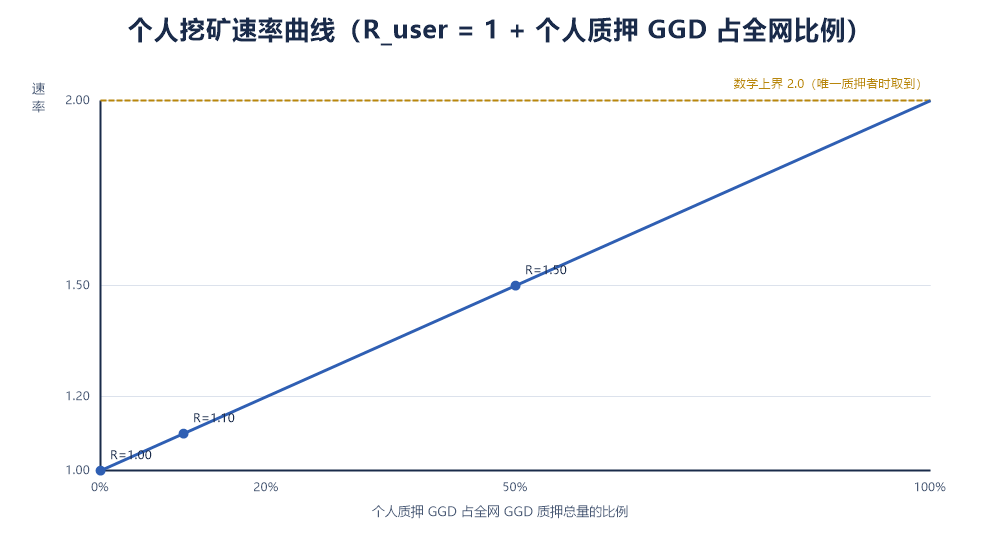
Figure 7-1: The relationship between personal mining rate and pledge ratio
7.2.6 GGD Pledge and Release Rules
| rule item | content |
|---|---|
| Pledge method | Users stake GGD through any node, and the pledge amount is included in the personal mining rate |
| Rate starting time | After staking for 24 hours, it will be included in the personal mining rate R_user (the same as 8.5.2 section income calculation rules); the withdrawal rate will be calculated immediately after the unstaking is initiated, and it will no longer occupy the total pledged share of the entire network. |
| voting rights | Users who pledge GGD retain governance voting rights and can participate in voting through nodes |
| Pledge lock-up period | Unstaking can only be initiated after 15 days have passed since the pledge was successful. |
| Release time | The deposit will arrive in 24 hours after initiating the unstaking. |
GGD The pledge lock-up period (15 days) and the release time (24 hours) are initial parameters and can be adjusted through the DAO governance vote.
7.3 Node responsibilities and values
- Provide GGT/GGU staking channel for ordinary users (user staking must be done through nodes);
- Provide GGD pledge and governance voting channels for third-party users;
- Dual-axis incentives: Node income depends on both "the GGD scale of its own pledge" and "the effective pledge scale of its users" - the former determines the node's basic rate R_node (7.5 section), and the latter is the enlarged subnet share base (8.4.3 section). The two are multiplied together and cannot exist without the other: only pledge GGD Without users, the income will be limited. If there are only users without staking GGD, then R_node = 1.0 will not gain any speed advantage;
- The higher the mining output of the node's users, the higher the node service fee income; the more the node pledges GGD, the higher R_node, the income of its users and the node will be amplified simultaneously, and the node will be more attractive to users;
- Therefore, nodes have the motivation to continue to maintain the pledge channel and absorb users' GGD pledge and their own pledge, forming dual demand and value support for the governance currency;
- Node exit: When a node exits or stops serving, the pledge share and income of its users will not be affected. Users can migrate their pledges to other nodes (not subject to switching cooling period restrictions), or directly release their pledges according to existing rules.
7.4 Node service fee
The node provides pledge channels and operation and maintenance services to its users, and obtains service fees from users' mining output in return.
7.4.1 Service fee mechanism
- Rate: The initial rate is 10% generated by user mining, which is unified across the entire network;
- Source: The service fee is deducted proportionally from the user's GGD mining output, without the user's additional payment; the user's gross output already includes the amplification of the node's basic rate R_node (see section 8.4.3), so the more the node pledges and the higher the user output, the greater the service fee base;
- Governable items: Service rates can be adjusted by the DAO governance vote.
7.4.2 Service fee allocation instructions
Take a user's daily output of 20 GGD as an example:
User mining daily output 20 GGD │ ├── Node service fee 10% ──► Node acquisition 2 GGD │ └── Users get 90% ──► Users get 18 GGD
7.4.3 Service fees and node incentives
- Service fees constitute the core source of income for nodes, motivating nodes to continue to maintain the pledge channel and attract more users to pledge GGD;
- The larger the user scale of the node and the higher the pledge amount → the greater the total user output → the higher the node service fee income, forming a positive cycle;
- The node service rate is set uniformly by DAO and is consistent for each node; when selecting a node, users can comprehensively compare the service quality, stability and ecological support of the node to select the optimal node;
- Nodes may not promise additional income or guaranteed income; any additional incentives provided by nodes themselves are not guaranteed by the protocol.
The service rate (10%) is an initial parameter and can be adjusted through the DAO governance vote.
7.5 Node GGD Staking and node base rate
The node's basic rate is an attribute of the node itself, which is determined by the amount of GGD pledged by the node: when only the pledge threshold amount (10,000 GGD) is pledged, the node's basic rate is the basic value 1.0; the more pledged parts exceed the threshold, the higher the node's basic rate.
7.5.1 Rate definition and formula
R_node = 1 + min[(S_node_GGD − S_min) ÷ S_GGD_total ,κ]
- R_node: Node basic rate coefficient (when only the pledge threshold amount is R_node = 1.0);
- S_node_GGD: The total amount of GGD currently pledged by this node (threshold pledge + excess pledge);
- S_min: Node threshold pledge amount, initial 10,000 GGD;
- S_GGD_total: The total amount of GGD pledged by users and nodes across the network (the same denominator as the 7.2.1 section);
- κ: Node rate capping parameter, initial 0.5, that is, the mathematical upper bound of R_node is 1.5.
7.5.2 Rate Example
Taking the total network GGD pledge amount of 5,000,000 tokens as an example:
| Node pledge GGD | Beyond the threshold | Proportion of the entire network | Node base rate R_node |
|---|---|---|---|
| 10,000 (threshold only) | 0 | 0% | 1.000 |
| 50,000 | 40,000 | 0.8% | 1.008 |
| 100,000 | 90,000 | 1.8% | 1.018 |
| 500,000 | 490,000 | 9.8% | 1.098 |
| 1,000,000 | 990,000 | 19.8% | 1.198 |
| 2,500,000 | 2,490,000 | 49.8% | 1.498 |
| ≥ 5,000,000 | — | ≥ 50% | 1.500 (capped) |
Note: The above table is an example. The actual rate changes dynamically with the total amount of GGD pledged in the entire network; when the total amount of pledged in the entire network increases, the proportion of existing nodes is diluted and the rate naturally drops.
7.5.3 Mathematical properties
- Boundedness: The formula contains capping parameters κ = 0.5, R_node ∈ [1.0, 1.5]; when the proportion of node over-pledge reaches 50%, it reaches the upper bound 1.5;
- Monotonicity: R_node strictly monotonically increases to S_node_GGD (when the cap is not reached);
- Marginal Decline: The rate gain of unit GGD decreases as the node pledge amount increases, and the greater the total pledge amount of the entire network, the smaller the gain for the same pledge amount;
- Threshold neutrality: The threshold pledge amount S_min itself does not produce any rate gain. The threshold is only an access condition and does not constitute a competitive advantage.
7.5.4 Node GGD Staking Rules
| rule item | content |
|---|---|
| Pledge lock-up period | Unstaking can only be initiated after the GGD pledged by the node reaches 90 days (distinguished from the 15 days pledged by the user to suppress short-term rate brushing behavior) |
| Rate starting time | After the pledge is full 24 hours will be counted into the node base rate R_node |
| Rate falls | After the unstaking is initiated, R_node will be immediately recalculated based on the remaining pledged amount, and the output of its users will be calculated simultaneously based on the new R_node |
| Relation to R_user | The GGD pledged by the node is only counted as R_node, not the node's own R_user (to avoid double counting) |
| Dynamic adjustment | The threshold amount, cap parameter κ, and lock-up period can all be adjusted by the DAO governance vote |
The threshold amount (10,000 GGD), capping parameter (κ = 0.5) and lock-up period (90 days) are all initial parameters and can be adjusted through the DAO governance vote.
7.6 User node selection and switching rules
Since user output also depends on R_node of the selected node (section 7.5), node selection constitutes a substantive economic decision, as the protocol clarifies as follows:
| rule item | content |
|---|---|
| information transparency | The pledge amount of each node, R_node and its effective pledge scale are publicly available on the chain, and users can compare in real time and choose independently. |
| Switch effective time | It will take effect 7 days after the user initiates the node switch; before it takes effect, the output will still be calculated based on the original node R_node |
| Switch cool down period | The interval between node switches for the same address shall not be less than 30 days. |
| Pledge Continuity | Switching nodes will not affect the continuity of staking, and the pledge share and generated income will not be reset by switching nodes. |
| Output attribution | The output before the switch takes effect will be returned to the original node subnet, and after it takes effect, it will be returned to the new node subnet, and the service fee will be attributed to the corresponding node. |
| Node exit | When a node exits or stops serving, its users can unconditionally migrate to other nodes without being restricted by the switching cool-down period. |
The switching effective time (7 days) and cooling period (30 days) are initial parameters and can be adjusted through the DAO governance vote.
Chapter 8 Pledge Mining Mechanism
Staking mining is the only way to release GGD's initial ecological mining share (45%); after the mining pool is about to be released or has been released, DAO can vote to repurchase GGD and inject continuation incentives into the mining pool (see sections 8.6 and 11.3 for details).
8.1 How to participate
- Users pledge GGT or GGU and obtain GGD rewards according to the rules;
- If GGU is pledged, the agreement will automatically convert it to the equivalent value GGT based on the market price of GGU every day, and then multiply it by the 0.9 coefficient and include it in the pledge share.
8.2 Minimum staking requirements
- The minimum single pledge quantity is 10 GGT (or GGU which is equivalent to 10 GGT - that is, the effective quantity after being converted to GGT at the market price and multiplied by the 0.9 coefficient is not less than 10 GGT).
8.3 Node channel
- All user pledges must be conducted through nodes and cannot be pledged directly by bypassing nodes;
- Users can independently choose nodes with better stability, service quality, community support and historical operating performance;
- The pledge scale and node base rate of each node R_node are publicly available on the chain. User output changes with the selected node R_node (see sections 7.5 and 7.6 for details). Node selection therefore directly affects mining output.
8.4 Staking mining algorithm
8.4.1 Four-factor model
The actual mining output of the user is determined by the following four factors:
| factor | symbol | Description |
|---|---|---|
| ① Pledge GGT quantity | S | The effective quantity after the pledged assets are converted into GGT determines the output base |
| ② Current pledge amount across the entire network | W_total | The sum of the effective shares of each node sub-network in the entire network is used as the denominator to dilute the unit share output |
| ③ User’s personal mining rate | R_user | Personal rate (see section 7.2 for definition, algorithm and mathematical properties), which amplifies user output |
| ④ The basic rate of the node it belongs to | R_node | The basic rate of the node selected by the user (see the 7.5 section for details on definition, algorithm and mathematical properties), which multiplies the effective share of all users under the node |
8.4.2 Effective pledge share
The user’s effective pledge share is calculated according to the following formula:
W_user = S × R_user
- S (effective pledge quantity): If GGT is pledged, S is the pledge amount; if GGU is pledged, the GGU market price will be converted into the equivalent value GGT every day and then multiplied by the 0.9 coefficient to be included, that is S = GGU Market price conversion GGT Quantity × 0.9;
- Staking method (only unlimited staking): GGT/GGU There is no time limit option for staking, only unlimited staking. Unstaking can be initiated at any time after staking (the unstaking is credited 24 hours, see section 8.5); therefore, there are no arrangements such as time weight bonus, lock-up period and early release, and the pledge share is only determined by the pledge amount and personal mining rate;
- R_user (personal mining rate): = 1 + user pledge GGD as a proportion of the total GGD pledge in the entire network (see section 7.2 for complete definition, examples and mathematical properties);
- Node subnet share: the sum of the effective shares of all users under the node, amplified by the node's basic rate and included in the denominator of the entire network:
W_subnet = R_node × Σ(W_user of users under this node)
W_total = Σ Subnet share of each node
Where R_node is the base rate of the node (see section 7.5 for complete definition). The actual allocated share of the user is W_user × R_node.
8.4.3 Daily output allocation and service fee deduction
The daily GGD mining output of the entire network is distributed according to the effective pledge share of each user, and the node's basic rate acts on its subnet share in the form of multiples:
Gross user output = (W_user × R_node) ÷ W_total × E_day
W_total = Σ Subnet share of each node = Σ [R_node × Σ(W_user)] of users under this node
User take-home output = gross output × (1 − node service rate)
Conservation: W_total consists of the subnet share of each node, so Σ the gross output of all users is equal to E_day - the node base rate only changes the distribution ratio between users and does not change the total amount released by the entire network (consistent with 7.2.4 section).
- E_day: The amount of GGD mining release in the entire network on that day, determined by the number of batches within the release window on that day (see 8.4.5 section for details);
- Boundary situation - W_total = 0: If the effective pledge share of the entire network on a certain day is zero (W_total = 0), E_day will not be allocated on that day; the batch release timing proceeds normally (730 The fixed window will not be postponed), and after expiration, the unallocated amount will be automatically transferred to the reserve account and managed separately from the active mining pool balance (see sections 8.4, 5.4 and 11.3 for details);
- Boundary situation - after batch expiration: After all batches expire E_day = 0, regardless of whether W_total is zero, no output can be distributed; after the active balance of the mining pool is exhausted, DAO can decide to inject the reserved reserves into the mining pool to continue the incentive, and start repurchase replenishment for the insufficient part (see section 11.3 for details);
- W_total: The sum of the subnet shares of all nodes in the entire network (R_node amplified). The greater the amount of pledges in the entire network, the lower the output per unit share, allowing the output to be automatically adjusted with the scale of participation;
- Node service rate: initially 10%, the node obtains the service fee proportionally from the user's gross output (see section 7.4 for details).
8.4.4 Calculation example
Assume that a user pledges 1,150 GGT (unlimited pledge) through a node, and at the same time pledges 100,000 GGD (the total amount of GGD pledged on the entire network on that day 5,000,000, the personal rate is R_user = 1 + 100,000 ÷ 5,000,000 = 1.02), node service rate 10%:
- Effective pledge share: W_user = 1,150 × 1.02 = 1,173;
- Assume that the entire network on that day W_total = 11,730,000 has 2 batches in the release window on that day, E_day = 2 × 61,644 = 123,288 GGD;
- The user's gross output on the day = 1,173 ÷ 11,730,000 × 123,288 ≈ 12.33 pieces GGD;
- Node service fee = 12.33 × 10% ≈ 1.23 pieces GGD (returned to the node);
- The actual output of the user on the day is = 12.33 × 90% ≈ 11.10 pieces GGD.
If the user pledges GGU, he must first convert GGU into the amount of GGT based on the market price on the day, multiply by 0.9, and then substitute it into the above formula for calculation.
Example of node base rate: Following the above example, assume that the user pledges through node A, and node A pledges GGD 1,000,000 coins (the total amount of GGD pledged in the entire network on that day is still 5,000,000 coins):
- Node A exceeds the threshold part = 1,000,000 − 10,000 = 990,000;
- Node base rate: R_node = 1 + min(990,000 ÷ 5,000,000, 0.5) = 1.198;
- The user’s actual allocated share = W_user × R_node = 1,173 × 1.198 ≈ 1,405.25;
- Assume that the node's subnet share is W_subnet = 119,800, the entire network W_total = 11,730,000, E_day = 123,288, then the user's gross output is = 1,405.25 ÷ 11,730,000 × 123,288 ≈ 14.77 pieces GGD;
- The actual output of the user is = 14.77 × 90% ≈ 13.30 pieces GGD; the node service fee is = 14.77 × 10% ≈ 1.48 pieces GGD.
If the user changes to the node B (R_node = 1.000) that only pledges the threshold amount (10,000 GGD), and the pledged assets are exactly the same, the gross output will fall back to ≈ 12.33 pieces GGD, and the actual income will be ≈ 11.10 GGD——Due to different selected nodes, the output of the same pledge differs by about 19.8%.
The above GGU conversion coefficient (0.9), E_day release curve, etc. are all initial parameters, which are ultimately subject to the on-chain contract and can be adjusted by DAO governance voting.
8.4.5 E_day Daily release curve
E_day (the mining release amount of GGD in the entire network on that day) is determined by the superposition of each unlocking batch currently in the release period.
8.4.5.1 Core Rules
| rule item | content |
|---|---|
| unlock trigger | GGT For every cumulative minting of 32,150,700 pieces (approximately 1 tons of gold), the next batch of 95,000,000 GGD is unlocked; the first batch (95,000,000 GGD) is unlocked at the protocol launch. |
| Mining pool injection | Out of each batch of 95,000,000 GGD, 45,000,000 are injected into the ecological mining pool; 50,000,000 pieces for private placement are not subject to batch unlocking restrictions. |
| release cycle | Each batch of 45,000,000 GGD is released linearly and evenly over 730 days (2 years) from the date of unlocking, and stops upon expiry. |
| Overlay rules | When the release windows of multiple batches overlap, the daily release amount is the sum of the release amounts of each batch. |
8.4.5.2 Single batch daily release volume
A single batch of 45,000,000 GGD is released evenly over 730 days:
Single batch daily release = 45,000,000 ÷ 730 ≈ 61,643.84, rounded to 61,644 GGD/ days
Each batch is timed independently: the unlocking day is counted as the 1 day, and the 730 day is the last day. After expiration, the batch will stop being released.
Rounding and doomsday balance rules: The injection amount of each batch is released every day on 1–729 days ÷ 730 The daily release amount after rounding, the 730 day (last day) is released according to the remaining amount (= injection amount − daily release amount × 729), ensuring that the total amount released in each batch is exactly equal to the injection amount, and there is no over-issuance; the superposition of multiple batches is calculated according to E_day = Σ the daily release amount of each active batch (if that day happens to be the last day of a certain batch, the batch will be calculated as the balance).
8.4.5.3 Daily release formula
E_day = Σ Daily release volume of each active batch
The daily release amount for each batch = the injection amount of that batch ÷ 730 days (rounded to the nearest whole number, with the last day adjusted according to the remaining amount). For the initial 45,000,000 batches, the daily release amount is fixed at 61,644 GGD/day; for repurchased batches, the daily release amount is recalculated based on their actual injection amount.
For example (with initial batch only):
- Only the 1th batch is within the window → E_day ≈ 61,644 GGD/ days;
- The 1th batch + the 2th batch are within the window → E_day ≈ 123,288 GGD/ days;
- The 1, 2, 3 batches are within the window at the same time → E_day ≈ 184,932 GGD/ days (61,644 × 3).
8.4.5.4 Mining pool balance
The balance of the mining pool is also affected by daily release consumption, new batch unlock injection and retention transfer:
M_remaining(t+1) = M_remaining(t) − E_day(t) + Δ_unlock − Δ_reserve
Where Δ_unlock = the amount injected from a new batch unlock or the amount injected from a pool supplement repurchase; Δ_reserve = the undistributed amount transferred to the retained reserve when the batch expires (if there is a batch expiration on the day and there is undistributed retention, it will be transferred according to the actual retained amount). At the start of the protocol, the initial value of M_remaining is 45,000,000 (first batch injection).
Reserved reserves: GGD that is not allocated due to W_total = 0 within the batch 730 day release window will be automatically transferred to the reserved reserve account on the batch expiration date and managed separately from the active mining pool balance; reserved reserves are not included in the active balance of the mining pool and do not participate in the calculation of E_day, and their use must be done by DAO Governance vote approval (see section 11.3 for details).
8.4.5.5 Release window alignment overview
Assume that GGT advances at an average annual growth rate of approximately 1 tons (32,150,700 pieces):
| unlock batch | GGT Trigger amount | Unlock time | release window | Active batches N_active | E_day (GGD/ days) |
|---|---|---|---|---|---|
| Batch 1 | 0 (start) | Year 0 | Years 0–2 | 1 | 61,644 |
| Batch 2 | 32,150,700 pieces | Year 1 | Years 1–3 | 2 | 123,288 |
| Batch 3 | 64,301,400 pieces | Year 2 | Years 2–4 | 2 | 123,288 |
| … | … | … | … | … | … |
| Batch 10 | 289,356,300 pieces | Year 9 | Years 9–11 | 2 | 123,288 |
| All due | — (950,000,000 tokens unlocked in batches, no new batches will be triggered; private placement 50,000,000 tokens are not subject to batch unlocking restrictions) | End of year 11 | — | 1 → 0 | 61,644 → 0 |
Note: N_active in the table is the number of active batches at the time when the batch is unlocked; as the old batches expire, the number of active batches in the later period of the window decreases accordingly (for example, in the 10-11 period of the 10 batch window, only the 1 batch remains online).
- Year 1: Only batch 1 is online, released on day 61,644 GGD;
- Year 2–10: There is always 2 batch release window overlap, and the daily release is stable at 123,288 GGD;
- Year 11: The 1–9 batches have expired, leaving only the 10 batch, and the daily release dropped back to 61,644 GGD;
- At the end of the 11th year: the 10th batch expires and all ecological mining shares are released.
The above example is based on the assumption that GGT has an average annual growth of approximately 1 tons (32,150,700 pieces). GGT If the growth is faster, the batches will overlap more, the daily release peak will be higher, and mining will end earlier; if the growth is slower, the overlap will be less and the duration will be longer. The release window and overlay of each batch depend on the actual casting progress of GGT.
Key design implications:
- Simple and predictable: In the initial batch stage, anyone only needs to count the number of batches currently within the release window, and can mentally calculate the release volume of the entire network that day, without needing to care about intermediate variables such as the epoch, halving factor, or mining pool fullness;
- Self-balancing rhythm: GGT The faster the growth, the more batch overlap and the stronger the release, but the total amount of ecological mining remains constant 450,000,000 GGD, consumption also accelerates, and mining ends sooner; conversely, the release is more gradual and the cycle is extended — the incentive intensity automatically matches the growth rate of the gold reserve;
- Relatively smooth: Compared with the halved model, each batch is released independently at a constant speed, with no release spikes or depletion breaks after superposition, and the overall release rhythm is smoother; however, when a new unlocked batch is triggered, the daily release amount still changes in a stepwise manner;
- Exactly consistent with the 6.3 section: mining pool injection rhythm = GGD batch unlocking rhythm, each batch of unlocking starts 730 and is released at a constant pace every day, with no interruption, no empty window, and no over-issuance.
8.5 Pledge and Release Rules
8.5.1 Unlimited pledge
GGT/GGU There is only one way of staking: "Indefinite Staking". There are no time options, time weights, lock-up periods and early release arrangements:
- Can be released at any time: After staking, you can initiate release at any time, there is no lock-up period limit, and there is no early release penalty or output recalculation;
- Continuity of pledge: The pledge continues to be valid until the user actively initiates the release of the pledge. During this period, the pledge amount can be added at any time, and the additional part will be combined with the original pledge to calculate the share;
- The difference from GGD staking: The rules in this section only apply to GGT/GGU mining pledge; user GGD’s pledge is still set to 15 days’ lock-up period (section 7.2.6), node GGD’s pledge is still set The 90 day lock-up period (sections 7.5.4) is an independent time rule for governance currency pledges.
8.5.2 General time rules
- Starting calculation rules: Mining income will start to be calculated after 24 hours have been pledged;
- Release of pledge to account: After release of pledge, the pledged assets will take 24 hours to arrive in account;
- Node GGD pledge: The lock-up period of GGD pledged by the node is 90 days (see section 7.5.4 for details), which is longer than the 15 days pledged by ordinary users; after the node unstaking is initiated R_node It fell back immediately, and its user output was calculated simultaneously according to the new R_node.
This design aims to reduce the frequent entry and exit of short-term speculative funds and maintain the stability of the pledge pool.
8.6 Mining incentive continuation mechanism
The total quota for ecological mining is 450,000,000 GGD (accounting for 45% of the total). This quota does not exist all at once at the start of the protocol, but is unlocked in batches of 95,000,000 GGD and released into the mining pool in installments of 45,000,000 per batch. When the mining pool is about to be depleted or has already been depleted, DAO can approve the replenishment of the mining pool through governance voting (with priority given to input from retained reserves, and any shortfall purchased from the secondary market) and continue to distribute according to the linear release rule over 730 days (daily release amount = injected amount ÷ 730), allowing the staking mining incentives to continue (trigger conditions and replenishment rules are detailed in section 11.3).
Chapter 9 Fee System
The protocol achieves ecologically sustainable operation through reasonable fee design, and all rates can be adjusted through DAO voting.
9.1 On-chain transfer fee
There is currently no protocol fee for on-chain transfers, and you only need to pay the gas fee of the blockchain network where you are located.
9.1.1 GGT and GGU transfer
- Current rate: 0 (no protocol handling fee is charged, only the gas fee of the blockchain network where it is located is paid);
- Contract rules: GGT/GGU Transfer is a permissionless operation and is still subject to smart contract rules;
- Future adjustments: GGT/GGU Whether to charge transfer fees, as well as the rate level and cap value, will be decided by the community (DAO) governance vote.
9.1.2 GGD Transfer
- Current rate: 0 (No protocol handling fee is charged, only the gas fee of the blockchain network where it is located is paid).
The protocol currently does not charge protocol fees for on-chain transfers of GGT, GGD, and GGU. Users only need to pay the gas fee of the blockchain network where they are located to reduce the friction costs of governance participation, pledge operations, and token circulation; among which GGT and GGU Whether to charge transfer fees in the future will be decided by the community (DAO) governance vote.
9.2 GGT ↔ GGU Interchange channels
- Conversion mechanism: The protocol provides an on-chain atomic transfer channel between GGT and GGU, which is converted according to the protocol reference price - GGU exchange quantity = GGT quantity × (GGT reference price ÷ GGU reference price), and the reverse is the same; where GGT The reference price is the gold reference price aggregated by multi-source oracles in 5.4, and the reference price in GGU is fixed at 1 US dollars. The mutual transfer is achieved by destroying the source token and minting the target token. The GGT minting generated by the mutual transfer is included in the cumulative minting amount of GGT (see the 6.3 section for details); the mutual transfer does not involve the entry and exit of the underlying gold assets and does not affect the protocol reserve scale;
- Mutual transfer rate: The mutual transfer rate is set by DAO governance voting (including whether to differentiate according to direction).
9.3 Minting and redemption fees (protocol level)
The handling fees related to minting and redemption are based on actual operating conditions and are set and adjusted by DAO governance voting.
9.4 Cost design logic
- Reduce circulation friction: There is currently no agreement fee for on-chain transfers, reducing the friction costs of governance participation, pledge operations and token circulation;
- On-chain execution: The setting and adjustment of fee rates (including GGT/GGU whether to charge transfer fees in the future) are subject to community (DAO) governance voting.
Chapter 10 GGD Governance Mechanism
The GGD protocol adopts the DAO governance model, and the control of the protocol belongs to the GGD currency holder community.
10.1 Governance Scope
GGD Governance covers five core areas of the protocol:
10.1.1 Parameter adjustment
- The minimum pledge amount of the node;
- Node base rate related parameters (threshold amount S_min, capping parameter κ, node GGD pledge lock period, node rate starting time);
- User node selection and switching rules (switching effective time, switching cooling period);
- GGT / GGU Transfer rate and cap value (GGT/GGU Whether to charge transfer fees in the future will be decided by community governance voting);
- GGT / GGU Various redemption rates;
- GGT↔GGU Interchange rate (including whether differentiated by direction);
- User mining rate formula parameters (base and gain coefficient; governance can also introduce capping parameters);
- Other protocol operating parameters.
10.1.2 Vault use
- DAO Direction of use of foundation share (15%);
- Distribution and expenditure of agreement income;
- Appropriation of ecological incentives and market incentive budgets.
10.1.3 DAO Organizational Income Disposition
- Agreement on the use, retention, ecological expenditure, buyback or other disposal arrangements of revenue, surplus or treasury assets;
- The method, proportion and time node of disposal are determined by DAO governance voting.
10.1.4 Contract upgrade
- Core contract upgrade proposals and voting;
- Decision to launch new functional modules.
10.1.5 Emergency pause
- When security risks, major vulnerabilities or extreme market conditions occur, the emergency suspension mechanism can be triggered through the governance process to protect the security of user assets.
10.2 Governance Principles
- One coin, one vote: GGD holdings are used as the basis for voting weight;
- On-chain execution: Proposals passed through voting are automatically executed through smart contracts to ensure that the governance results are non-tamperable and transparent;
- Gradual decentralization: The protocol development is guided by the core team in the early stages. As the circulation of GGD deepens, the governance rights are gradually and completely transferred to the community.
10.3 Governance voting mechanism
GGD Governance adopts a three-stage on-chain governance process of proposal-voting-execution, and all operations are automatically executed through smart contracts.
10.3.1 Proposal initiated
| elements | rules |
|---|---|
| Proposal threshold | You must hold the address ≥ 100,000 GGD to submit a governance proposal |
| Proposal content | Must include proposal title, detailed description, and contract call parameters to be executed (if applicable) |
| Proposal deposit | Submitting a proposal requires locking 10,000 GGD as a deposit; it will be fully refunded after the proposal is passed; if the proposal is not passed (including failure to reach the quorum), 100 GGD will be deducted and transferred to DAO treasury, and the remaining 9,900 GGD will be returned |
| Proposal type | ① Parameter adjustment proposal; ② Treasury expenditure proposal; ③ Contract upgrade proposal; ④ Emergency suspension proposal; ⑤ Other general proposals |
10.3.2 Voting process
| elements | rules |
|---|---|
| voting period | Standard proposal 30 days; Emergency proposal 7 days |
| voting weight | 1 GGD = 1 votes; pledged GGD votes are counted directly based on the starting snapshot of the voting period. Unpledged votes are locked at the time of voting and unlocked after the end; the same proposal at the same address is only counted once for weight, and repeated votes are not allowed after the snapshot is released. |
| voting options | For / Against / Abstain |
| Quorum (Quorum) | Standard proposal ≥ circulation 5%; emergency suspension proposal ≥ 10%; abstention votes are included in the total number of participants, and proposals that do not reach the quorum will automatically expire |
| pass conditions | Denominator of vote counting = yes votes + no votes (abstention votes are not counted): Standard proposal > 50% requires a simple majority; major proposals (contract upgrades, over-limit treasury expenditures) and emergency suspension proposals require the approval of ≥ 2/3 (66.7%) |
| voting changes | Changes in votes are allowed during the voting period, and the last vote shall prevail. |
10.3.3 Proposal Execution
| elements | rules |
|---|---|
| Execution delay (Timelock) | After the proposal is passed, it must go through the 24 hour time lock before it can be executed for community review and response. |
| Automatic execution | After Timelock expires, anyone can trigger contract execution and the proposal content will automatically take effect. |
| void after expiration | If the passed proposal is not triggered for execution within 7 days, it will automatically be invalidated. |
10.3.4 Emergency management
The agreement has two levels of emergency response: temporary suspension of the Security Committee (to respond to immediate attacks) and emergency suspension proposals (to respond to major governance matters).
① Temporary suspension of the Safety Committee
| elements | content |
|---|---|
| Setup and permissions | At the beginning of the agreement, a security committee controlled by multi-signatures (3-of-5) was established, with temporary suspension authority of up to 72 hours; members of the security committee are appointed and removed by DAO governance voting |
| permission boundaries | Only high-risk operations (subscriptions and redemptions, key contract entries, etc.) can be suspended. User assets are not allowed to be transferred, parameters are not allowed to be modified, and treasury is not allowed to be used. |
| ratified afterwards | After the temporary suspension is activated, an emergency proposal must be submitted to DAO within 72 hours, and the community will vote to extend, lift, or take repair measures; if no proposal is submitted within the time limit, the temporary suspension will be automatically lifted. Once an emergency proposal is submitted within 72 hours, the temporary suspension is automatically extended until the end of the voting period for the proposal to avoid a protective window between the suspension being lifted and the proposal taking effect. |
| Transparency | The trigger, operation content and multi-signature signing records of the temporary suspension are all publicly available on the chain and disclosed to the community immediately. |
② Emergency suspension proposal
- Emergency suspension proposals are subject to fast track: the voting period is shortened to 7 days and will be implemented immediately after passing (without Timelock);
- The activation of emergency suspension must meet both a higher quorum (≥ 10% of the current circulation) and a higher passing condition (≥ 2/3 i.e. 66.7% agrees), and the double threshold prevents governance capture (governance capture) and abuse;
- Suspension extension: The temporary suspension of the Safety Committee will be automatically extended until the end of the voting period after the emergency proposal is submitted (see ① for details);
- Recovery plan: After the emergency suspension proposal is passed, a separate recovery plan proposal must be submitted to explain the reasons for the suspension, repair measures and recovery timetable.
10.3.5 Governance flow chart
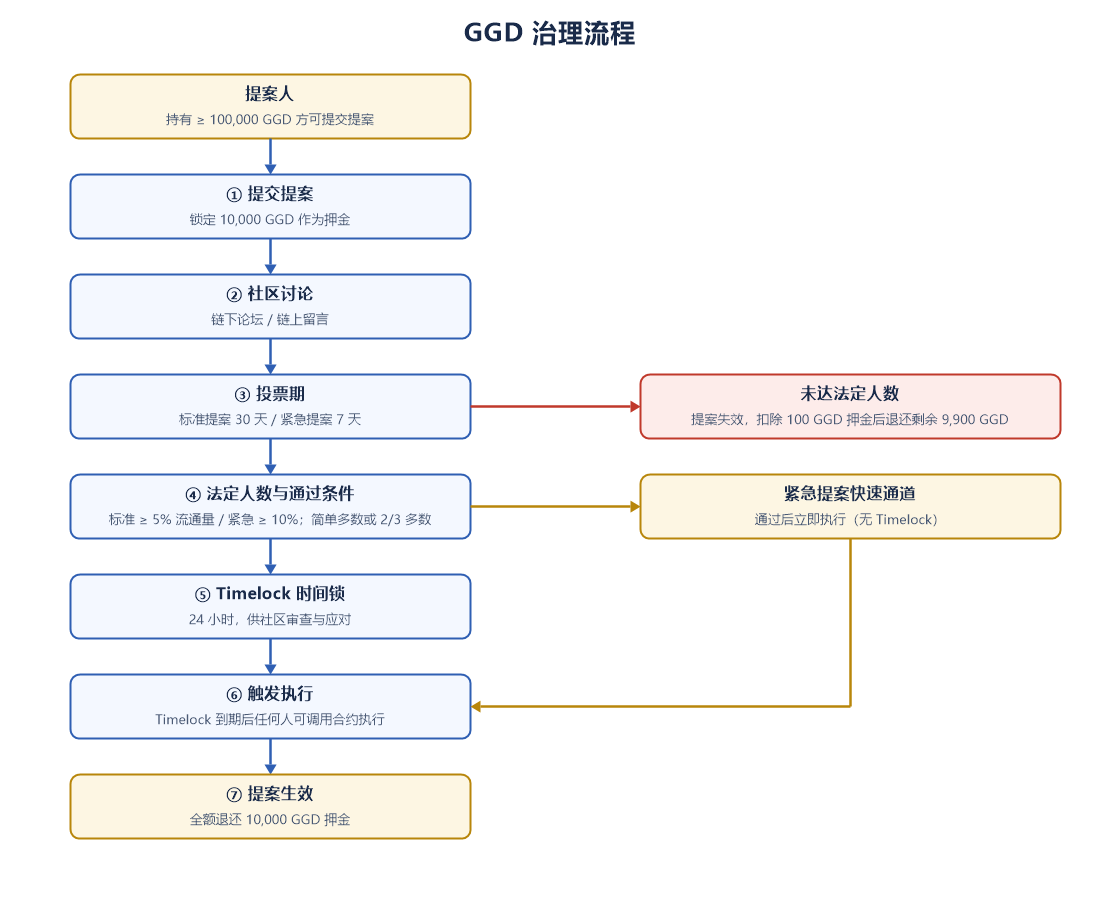
Figure 10-1: GGD governance process
The above proposal threshold, deposit amount, voting period, quorum ratio, passing conditions, Timelock duration, etc. are all initial parameters and can be adjusted through the DAO governance vote.
Chapter 11 Buyback and Market Adjustment Mechanism
11.1 GGD Buyback mechanism
- Activation Conditions: When GGD achieves full circulation (after 950,000,000 tokens are unlocked in batches, private placement 50,000,000 tokens are not subject to batch unlocking restrictions, and team/private placement vesting is completed, with mining pool replenishment and repurchase not affecting this determination, see section 15.1 for details), the GGD repurchase mechanism will be activated;
- Decision-making method: Whether to execute the repurchase or not must be decided by DAO voting;
- Source of funds: Agreement income and treasury reserves.
11.2 Market-based token adjustment mechanism
When GGD enters the full circulation stage (see section 15.1 for details), DAO can decide by voting whether to adopt a market-based token adjustment mechanism, including but not limited to:
- Secondary market operations: adjust supply and demand according to market conditions;
- Token treatment plan: including but not limited to token destruction or other supply adjustment measures.
All regulatory actions are premised on governance voting and are publicly executed on the chain and subject to community supervision.
11.3 Mining pool supplementary buyback mechanism
When the initial 450,000,000 GGD of the ecological mining pool is about to be fully released or has been fully released, DAO can initiate the mining pool replenishment mechanism through governance voting, prioritizing registering the reserved storage into the mining pool, and any shortfall is then supplemented by repurchasing GGD from the secondary market, ensuring the continuation of mining incentives.
| elements | content |
|---|---|
| Trigger condition | The mining pool is about to run out of capacity: When the active balance of the mining pool is lower than the estimated release amount in 90 days (currently E_day × 90), a supplementary proposal can be initiated in advance to achieve seamless connection; or replenishment can be initiated at any time after the active balance of the mining pool reaches zero. Triggering is not based on "all batches are unlocked and expired" - within the gap window caused by the initial batch being released and subsequent batches not being unlocked, DAO also has the right to initiate replenishment to ensure the continuity of staking mining incentives |
| decision-making style | DAO Governance voting approval (following the standard proposal threshold: quorum ≥ circulation 5%, the yes vote accounts for a simple majority of the sum of yes + no > 50%; if the single replenishment amount exceeds the treasury expenditure threshold, it will be implemented according to the major proposal standards and needs to ≥ 2/3 (66.7%) agrees, see section 10.3.2 for details) |
| supplementary sources | The first order: Reserve reserve injection - GGD that has not been allocated and transferred to the reserve reserve due to W_total = 0 when the batch expires can be directly injected into the mining pool without repurchase; the second order: market repurchase - when the reserve reserve is insufficient, the agreement income and treasury reserves are used to repurchase from the secondary market GGD and inject |
| Injection rules | Whether it is reserved reserve injection or repurchase injection, it is allocated according to the 730 daily uniform linear release rule; daily release amount = injection amount ÷ 730 (rounded), and the last day is adjusted according to the balance; when superimposed with the initial batch, E_day = Σ is calculated as the daily release amount of each active batch (see details 8.4.5 section) |
| Liquidity processing | The GGD injected into the reserved reserves and repurchase will not be included in the circulation during the period when it is not released (the caliber is consistent with the unreleased part of the initial mining pool), and will be re-included after it is released. |
| Amount limit | The upper limit of a single replenishment amount is determined by DAO voting to prevent excessive consumption of treasury reserves |
| Transparency | Reserved reserve balances, supplementary transactions and mining pool balances are all publicly executed on the chain and subject to community supervision. |
The supplementary plan must fully disclose the supplementary amount, execution time window and source (reserve injection or market repurchase) through the DAO proposal. Only after the vote is passed, the injection operation can be completed publicly on the chain by the protocol execution layer.
Part 4 Operation and Planning
Chapter 12 Operational Organizational Structure
12.1 Top-level architecture: DAO Organization
GGD The governance and operations of the protocol are coordinated by a decentralized autonomous organization (GGD DAO). In this document, "DAO organization" refers to a community organization that relies on the GGD governance token and the on-chain governance mechanism. Its major decisions are generated through on-chain voting and automatically executed (see Chapter 10 for details).
12.1.1 Organizational structure and roles
DAO The organization is composed of the following roles, each role has clear responsibilities and authority is governed by governance:
| role | Responsibilities | Permissions/Thresholds |
|---|---|---|
| GGD Coin holder | Governance voting (1 GGD = 1 votes); initiating proposals must hold ≥ 100,000 GGD | You can vote with any holding amount; there are other thresholds for proposals (see section 10.3.1 for details) |
| node | Pledge channel, governance participation support, service fee settlement | Pledge ≥ 10,000 GGD (see section 7.1 for details); pledge exceeding the base rate of generating nodes R_node (see section 7.5 for details) |
| safety committee | Emergency temporary pause (up to 72 hours) | 3-of-5 multi-signature, members are appointed and removed by voting of DAO (see section 10.3.4 for details) |
| DAO Foundation | Treasury management, long-term ecological construction | 15% share, spending subject to governance proposal approval (see sections 6.2, 10.1.2 for details) |
| core team | Initial guidance, technical maintenance, and ecological development | 20% shares, 6 months Cliff + 18 months linear vesting (see section 6.3 for details) |
| Authorized Executor/Service Provider | Execute off-chain operations according to governance-approved parameters and limits | Multisig members are appointed and removed by voting from DAO (see sections 2.2.1, 10.3.4 for details) |
DAO The organization does not have a currency-holding threshold for membership - any GGD currency holder automatically has voting rights, and participation qualifications follow the "one coin, one vote" principle of 10.2.
12.1.2 Decision-making hierarchy
DAO The organization’s decision-making is divided into three levels based on authority and timeliness:
- Community voting (highest decision-making power): GGD Token holders decide on major matters such as protocol parameter adjustment, treasury use, contract upgrades, emergency suspensions, etc. through the proposal-voting-execution process (see 10.1, 10.3 sections for details);
- Safety Committee (Emergency Authority): Initiate a 72 hour temporary suspension when an immediate security risk occurs, and a DAO emergency proposal must be submitted afterwards for ratification (see section 10.3.4 for details);
- Authorized executor (execution authority): Perform off-chain hedging, reserve accrual and other operations within the parameters and limits approved by governance, subject to the 3-of-5 multi-signature constraints (see 2.2.1 section for details).
12.1.3 Checks and balances
- The security committee can only suspend high-risk operations, and is not allowed to transfer user assets, modify parameters, or use the treasury; DAO ratification must be submitted within 72 hours (see section 10.3.4 for details);
- Authorized executor multi-signature members are appointed and removed by voting DAO, and the execution team does not have the power to independently dispose of treasury assets (see sections 2.2.1, 10.3.4 for details);
- DAO Foundation expenditures are subject to governance proposal approval (see sections 10.1.2 for details);
- Hedging and reserve limits: The ratio of the single-day hedging scale limit and the reserve usage limit must be set by governance, and operations exceeding the limit must be separately voted by DAO (see sections 2.2.1 for details);
- Gradual decentralization: The protocol development is guided by the core team in the early stages. As the circulation of GGD deepens, the governance rights are gradually and completely transferred to the community (see sections 10.2 and 13.3 for details).
12.2 Token issuance structure
There are structural differences between the issuing entities and underlying structures of the three types of tokens. The unified comparison is as follows:
| Token | Issue execution | control | underlying assets | Description |
|---|---|---|---|---|
| GGT | RWAfi DAO LLC - Series 2 (Legal Issuer); AXC Labs (Issuance and Technical Service Provider) | Protocol layer parameters and contract control rights ownership GGD DAO | CSOP Gold ETF (3030.HK); physical gold will be added later | RWA Token, the underlying assets must be held by a legal entity (see Chapters 3 and 4 for details) |
| GGU | Protocol smart contract issuance | GGD DAO | 1 USD Equivalent Gold + Gold Hedging Short Order | Synthetic USD units, USD value stabilizes at 1 (see section 2.2 for details) |
| GGD | Protocol smart contract issuance | GGD DAO | None (governance token) | The total amount of 1,000,000,000 units is fixed and will be unlocked in batches (Private placement 50,000,000 units are not subject to batch unlock restrictions) (see Chapter 6 for details) |
Architectural points:
- Stratification of control rights: at the legal level, GGT is issued by legal issuers RWAfi DAO LLC - Series 2, and its LLC legal control rights are exercised by a single member/management of the entity; at the on-chain level, the protocol layer parameters and contract control rights of the three tokens are vested in GGD DAO, through GGD Governance mechanism upgrade contract and adjustment parameters;
- The execution path is divided into two paths: GGT is issued by the legal issuer Series 2, AXC Labs provides issuance and technical services (Series DAO LLC holds the underlying gold assets), GGU and GGD are issued by GGD The protocol smart contract directly mints/destroys;
- Closed-loop coupling: The three form an economic closed loop through protocol exchange channels (GGT↔GGU), staking mining (GGT/GGU→GGD) and governance voting (GGD adjusts the parameters of the three) (see section 2.4 for details);
- Legal and on-chain separation: The legal structure of GGT is detailed in Chapter 4 (Master/Series DAO LLC, SPV segregation, liquidation rights), and the tokens do not constitute an equity or membership claim to Master/Series DAO LLC or any underlying assets/entities (see sections 4.3, 4.4 for details).
12.3 Issuance Service Provider: AXC
- AXC Labs is the issuance and technical service provider of GGT (blockchain service provider, registered in the Cayman Islands), providing professional services for the issuance, technical deployment and compliance process of GGT, and charging management fees for the operation of token-related platforms (see section 4.2 for details);
- AXC and SPV are legally independent from each other, and claims against AXC will not extend to the assets held within SPV.
12.4 Asset custody and management agency
For a complete list of underlying fund managers, custodians, gold custodians, trustees and registries, compliance technology service providers and other institutions, please see Chapter 3 3.3 and appendix 15.3 "List of Key Institutions" for details.
12.5 Architecture diagram
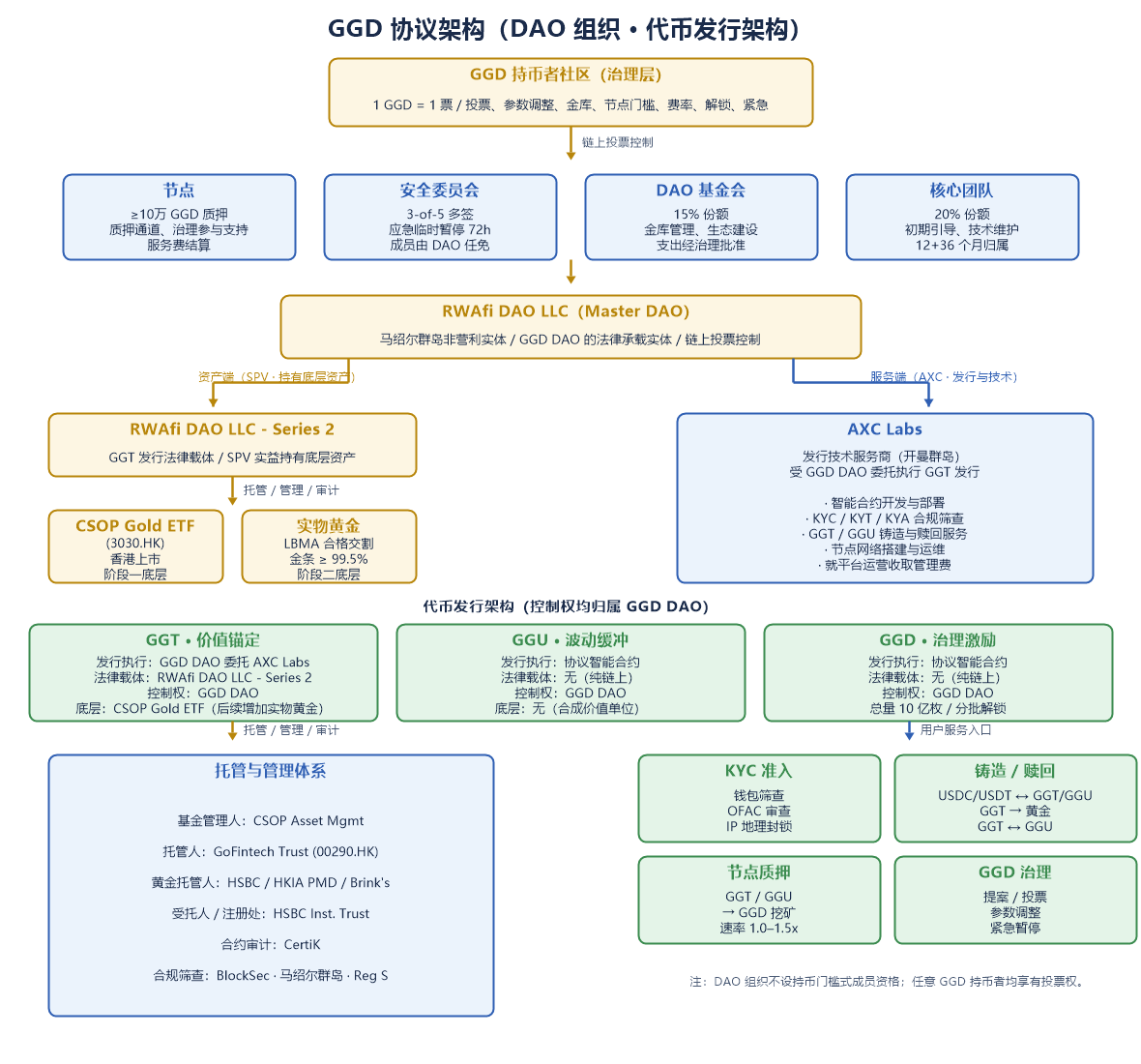
Figure 12-1: GGD protocol architecture diagram (including DAO organizational structure and token issuance structure)
Chapter 13 Development Roadmap
The following roadmap is planning content, and the actual progress may be adjusted based on market environment and governance decisions.
13.1 Phase 1: Foundational Period
- GGD will be officially released on BNB Chain, with the first batch of 95,000,000 unlocked, and the private placement of 50,000,000 not subject to phased unlocking restrictions;
- Node recruitment is started, and the staking mining function is online;
- GGT The casting and redemption channel is opened (USDC/USDT Subscription and redemption);
- GGT↔GGU The on-chain mutual transfer channel is online (converted according to the agreement reference price, and the mutual transfer rate is set by the DAO governance vote, see section 9.2 for details).
13.2 Phase 2: Expansion period
- GGT The accumulated casting amount increases step by step, triggering GGD to be unlocked in batches;
- GGT The underlying asset adds directly held physical gold on the basis of gold ETF to build a "ETF + physical gold bar" composite asset base;
- GGU The hedging mechanism continues to be optimized, and the ability to manage the fluctuations of pledged assets is enhanced;
- Ecological partner application scenarios are implemented.
13.3 Stage 3: Maturity
- GGD has entered the full circulation stage;
- Launch the GGD repurchase mechanism, and the market-based token adjustment mechanism will take effect after voting;
- When the mining pool is about to be exhausted or exhausted, DAO can vote to initiate market repurchase GGD to replenish the mining pool and continue staking mining incentives;
- Governance rights are completely transferred to the community to achieve fully DAO operations;
- Promote cross-chain deployment and multi-ecological expansion based on community decisions.
Part 5 Risks and Appendix
Chapter 14 Risk Warning and Disclaimer
14.1 Risk warning
market risk
- The market price of GGD is determined by supply and demand and may fluctuate significantly, and participants may face asset losses;
- GGT Although it tracks the price of gold, the price of gold itself also fluctuates due to the influence of the international market;
- GGU Although hedging short orders with 1 USD equivalent gold + gold has stabilized fluctuations (see 2.2.1 section for details), there is still a risk of price fluctuations, especially when reserves are insufficient in the early stages of the agreement and the hedging ratio is low, its USD value may deviate from 1 USD;
- If the hedging strategy is executed incorrectly or market liquidity is insufficient, risk reserves may be lost or even exhausted, and GGU prices may deviate significantly;
- Derivatives hedging risks: Gold short orders involve the credit risk of the derivatives counterparty/exchange, funding rates and basis costs, margin calls and forced liquidation risks; if the counterparty defaults or is liquidated due to insufficient margin, the hedging becomes invalid and the value of GGU US dollars may deviate from 1 US dollars;
Tracking error and price deviation risk
- The token issuer will use reasonable efforts to minimize tracking differences between GGT and the underlying CSOP Gold ETF, but tracking differences may still occur and the risk is borne by the token holder;
- The real-time liquidity framework and real-time price oracle may cause the token price to deviate from the underlying asset price;
- In the process of the evolution of the underlying asset from gold ETF to the composite structure of "ETF + physical gold", there may be risks of custody switching, operation connection and price fluctuation during the transition period.
Smart contract risks
- The protocol relies on smart contracts to run. Although the contract has undergone a third-party professional security audit, it still cannot completely eliminate unexpected risks such as vulnerabilities and attacks.
Regulatory Compliance Risk
- There are uncertainties in regulatory policies regarding crypto-assets and RWA tokenization in various regions around the world, and policy changes may have a significant impact on protocol operations;
- Users located in the United States, mainland China, or United Nations sanctioned jurisdictions are prohibited from participating in this Agreement, which has implemented IP geo-blocking;
- GGU Special regulatory risk: GGU subscribes with USDC/USDT and redeems USDC/USDT with 1 US dollar reference price, which may be regarded as a stable currency/electronic currency product in many jurisdictions (including Hong Kong's Stable Coin Ordinance, etc.); the characterization of "non-stable currency" in this white paper does not determine the regulatory determination, and regulatory agencies may GGU Impose stablecoin compliance requirements (e.g. reserves, redemptions, licenses, etc.). Participants should evaluate the relevant regulatory risks by themselves, and the Agreement does not guarantee this.
legal structure risk
- Tokens do not represent equity, ownership or trust interests in the issuer or underlying assets, and holders only have indirect economic exposure and limited legal recourse;
- Master/Series DAO LLC There is uncertainty about the recognition of the structure in some jurisdictions, and the specific remedies for holders in liquidation situations are determined by cross-jurisdictional case law.
Liquidity risk
- There is a 24 hour time rule for staking and unstaking, and participants may not be able to withdraw immediately under extreme market conditions;
- GGD pledge has a lock-up period of 15 days (section 7.2.6), and the pledge cannot be released during the lock-up period;
- GGT/GGU is pledged indefinitely and can be released at any time, but it will still take 24 hours (section 8.5.2) to release the pledge, and it may not be possible to withdraw immediately under extreme market conditions;
- There is a disclosure delay of T+5 to T+45 working days for off-chain asset information.
governance risk
- DAO The voting results may not meet the expectations of individual currency holders, and there is a risk of decision-making disagreements on parameter adjustment, vault use and other matters;
- Governance concentration risk: core team (20%) + DAO foundation (15%) + private equity (5%) together account for GGD total amount 40%, relative to 45% Ecological mining share, the early governance concentration of the protocol is relatively high; before the completion of "gradual decentralization", the team and the foundation may dominate governance decisions if they coordinate, and there are risks of governance capture (governance capture) and control by a few people.
Node mechanism risk
- Node concentration and the Matthew effect: user output changes with the R_node of the selected node, and high-staking nodes are more likely to absorb users and GGD pledges, forming a positive feedback of "the more pledges → the higher the rate → the more users", which may intensify the differentiation between nodes and amplify governance concentration; the capping parameter κ = 0.5 (7.5 section) is the only hard constraint and cannot completely rule out the situation where a single node aggregates a large number of pledges and users;
- The negative externality of node staking on users: GGD pledged by nodes is included in the denominator of S_GGD_total. An increase in the scale of node staking will dilute the R_user of all users. There is conflicting interest between nodes and users at the denominator level;
- Switching arbitrage risk: Under the constraints of the switching effective delay (7 days) and the cooling period (30 days), users may still periodically chase the highest R_node node, causing pledge shares to migrate between nodes and output fluctuations;
- Risk of revenue concentration: The upper bound of the output multiple of a single user is R_user (2.0) × R_node (1.5) = 3.0. In extreme cases, revenue distribution is highly concentrated;
- Node cold start dilemma: New nodes R_node = 1.0, which are equivalent to nodes that only pledge a threshold amount, may have difficulty obtaining initial users and pledges, forming a de facto barrier to entry.
Unlocking mechanism risk
- GGD Batch unlocking is triggered by the cumulative casting amount of GGT and is irreversible (see section 6.3 for details). If GGT is redeemed and destroyed in large numbers after being triggered, the actual gold reserve scale of the ecosystem may no longer match the unlocked GGD supply, and the relative reserve scale of GGD market supply may be too high; although the redemption fee and the occupation of real funds pose economic constraints to the "casting → redemption → recasting" unlocking behavior, the risk of caliber deviation under extreme circumstances cannot be completely ruled out;
- Inter-transfer brush unlocking risk: GGT cast in the GGU→GGT direction of the GGT↔GGU inter-transfer channel will be included in the cumulative casting amount (see 9.2 for details section), the attacker can use the "GGT→GGU→GGT" looping and interchanging path to increase the cumulative minting amount, thus triggering the GGD batch unlock. This path may weaken the inhibitory effect of the "redemption fee" mentioned in section 6.3 on the unlocking behavior and amplify the deviation between GGD supply and real gold reserves.
tax risk
- Participating in minting, redeeming, transferring, pledging, obtaining mining rewards, mutual transfer GGT/GGU or redeeming physical gold may generate income tax, capital gains tax, value-added tax, stamp duty, customs duties, excise tax or other tax obligations in different jurisdictions. The Agreement does not provide tax advice and participants should consult their own professional tax advisors.
14.2 Disclaimer
- This white paper is only an informational and educational document and does not constitute an issuance offer, subscription invitation or investment advice for any securities or financial products, nor does it form the basis for any contract or commitment;
- This agreement does not actively promote or sell to retail investors; participants should confirm on their own that they are qualified to participate in relevant digital assets, RWA products or similar products in their jurisdiction, and bear their own responsibility for investor suitability; the on-chain access control of the agreement (KYT/KYA and jurisdiction restrictions) is only used for address risk screening and restricted area blocking, and does not constitute verification of investor qualifications;
- GGD is a protocol governance and incentive functional token; GGT is a connected digital asset that tracks the performance of the underlying gold ETF (qualitatively consistent with 3.5). It does not represent equity or ownership of the issuer, LLC or the underlying assets. There is no trust, fiduciary or beneficial ownership relationship between the user and the issuer. GGU is a synthetic U.S. dollar unit collateralized by gold and hedged by delta. It is purchased with USDC/USDT and redeemed at the U.S. dollar reference price of 1. In some jurisdictions (including Hong Kong's Stablecoin Ordinance), it may be regarded as a stablecoin/electronic currency product. The characterization of this document does not determine regulatory determination (see 14.1 for details. section). The description of the legal properties of tokens in this document is based on the structural design of the issuer's current legal counsel and does not constitute a guarantee of regulatory characterization in any jurisdiction; the regulatory characterization of such arrangements may differ in different jurisdictions. GGT may be regarded as securities, collective investment plans, derivatives, structured products or other regulated products in some jurisdictions. Participants should confirm that their participation is in compliance with the legal requirements of the jurisdiction where they are located, and consult professional legal, tax and financial advisors on their own;
- Nothing in this document shall be construed as a warranty, representation or establishment of any obligation (contractual or otherwise) by AXC or its affiliates; AXC is only the issuer and technical service provider, and the legal issuer of GGT is RWAfi DAO LLC - Series 2 (see details Section 4.2), the two are mutually independent legal entities - the "issuer's commitment" mentioned in Section 4.5 only binds Series 2, not AXC;
- Participants should understand and abide by the laws and regulations of the jurisdiction in which they are located, and all consequences arising from illegal participation will be borne by the participants themselves;
- The protocol team, AXC and GGT issuance-related legal entities do not make any form of guarantee on the token price or mining income;
- The content of this white paper may be updated as the protocol iterates. The latest version shall be subject to official channels.
Chapter 15 Appendix
15.1 Glossary
| Terminology | Definition |
|---|---|
| RWA | Real World Assets, tokenization of real-world assets |
| GGT | Global Gold Token, gold RWA tokens, 1 GGT = 0.001 ounces of gold, the underlying assets are currently CSOP Gold ETF (3030.HK), and physical gold will be added in the future |
| GGU | Global Gold Unit, a synthetic U.S. dollar unit collateralized by gold and hedged by delta, 1 GGU = 1 U.S. dollar equivalent gold + gold hedged short order (the reference price is fixed at 1 U.S. dollars, and the U.S. dollar value stabilizes at 1), which is converted at the market price when pledging GGT × 0.9 included in the share |
| GGD | Global Gold DAO, protocol governance token |
| DAO | Decentralized Autonomous Organization |
| Master/Series DAO LLC | Marshall Islands Master/Series DAO LLC structure for asset holding and token issuance |
| SPV | Special Purpose Vehicle, special purpose vehicle to achieve bankruptcy isolation and asset isolation |
| LBMA | The London Bullion Market Association, whose gold fixing price is the global gold pricing benchmark |
| CSOP | CSOP Asset Management Co., Ltd., CSOP Gold ETF Fund Manager |
| KYB | Know Your Business, Corporate Due Diligence |
| KYT | Know Your Transaction, know your transaction (on-chain transaction compliance screening) |
| KYA | Know Your Address, know your address (on-chain address compliance screening) |
| HKIAC | Hong Kong International Arbitration Center |
| Regulation S | Foreign offering exemption rules under U.S. securities laws |
| Node base rate | Node’s own attribute coefficient, R_node = 1 + min[(node pledge GGD − threshold 10,000) ÷ total network GGD pledge amount, κ], κ = 0.5, value ∈ [1.0, 1.5], multiply the effective share of all users under the node (see section 7.5 for details) |
| Node subnet share | The sum of the effective shares of all users under the node is the share amplified by the basic rate of the node, W_subnet = R_node × Σ(users under it W_user); the denominator of the whole network W_total = Σ the subnet share of each node (see section 8.4.2 for details) |
| Personal mining rate | User's personal mining productivity coefficient, R_user = 1 + user pledge GGD as a proportion of the total network GGD pledge, ≥ 1.0, the mathematical upper bound is 2.0 |
| Full circulation | GGD 1,000,000,000 coins have all entered circulation (950,000,000 coins have been unlocked in batches + 50,000,000 private placement coins are not subject to batch unlocking restrictions), and the team/private placement allocation (vesting) has been fully released; the injection and release from the mining pool’s top-up repurchase does not affect the determination of full circulation status. |
| Circulation | The total amount of GGD that has been unlocked and vested (vesting has been released) (including GGD in the pledge lock warehouse), excluding the unlocked batches, team/private shares that have been unlocked but not vested, and the unreleased portion of the mining pool (including the unreleased portion of the initial mining pool and the unreleased portion after repurchase injection), is used as the denominator for the quorum calculation |
| Casting/Subscription | Users obtain newly issued GGT/GGU through the official agreement at USDC/USDT at the agreement reference price (primary market operation) |
| redeem | Users destroy GGT/GGU through the official agreement and exchange it for USDC/USDT at the agreement reference price (primary market operation); physical gold redemption is limited to GGT (see section 3.7 for details) |
| Swap/Exchange | Users trade according to the market price in the secondary market or liquidity pool, which does not involve new issuance or destruction of the agreement, and there is no guarantee that the transaction price is equal to the agreement reference price. |
| transfer | Users perform on-chain atomic conversion between GGT and GGU through the agreement at the agreement reference price, which involves destruction and casting, and does not involve the entry and exit of underlying assets. The mutual transfer rate is set by the DAO governance vote (see section 9.2 for details) |
| Reserved storage | The unallocated GGD due to W_total = 0 within the batch 730 day release window is an independent account transferred on the batch expiration date; it is not included in the active balance and circulation of the mining pool, and its use must be approved by the DAO governance vote (see details 8.4.5.4 section and 11.3 section) |
Unified terminology agreement: In this document, "DAO" refers to the general concept of decentralized autonomous organizations, "GGD DAO" specifically refers to the governance community of this protocol; "Master DAO LLC" and "Master DAO", "Series DAO LLC" and "Series DAO" respectively refer to GGT The same legal entity in the issuance structure can be interchanged according to the context; "AXC" and "AXC Labs" refer to the same issuance and technical service provider; RWAfi DAO LLC and RWAfi DAO LLC - Series 2 only exist as legal entities of the GGT issuance structure, and their meanings are based on Chapter 4 and 12.2 section is limited.
15.2 Core parameter cheat sheet
Parameters are divided into three layers according to governance attributes: structural parameters (basis of the protocol, cannot be adjusted by governance), governance parameters (can be adjusted by DAO voting), and derived parameters (derived from other parameters, automatically changed with linkage, cannot be adjusted individually).
① Structural parameters (cannot be adjusted by management)
| parameters | numerical value |
|---|---|
| GGD Total amount | 1,000,000,000 pieces |
| Amount of unlocked in a single batch | 95,000,000 pieces (a total of 10 batches, totaling 950,000,000 pieces; in addition, there are 50,000,000 pieces in private placements that are not subject to batch unlocking restrictions) |
| Unlock trigger conditions | GGT The cumulative casting amount is 32,150,700 pieces per full (approximately 1 tons, including mutual casting) |
| Total amount injected into the initial mining pool | 450,000,000 GGD (45% × 1,000,000,000, initial shares with structured lock; once the mining pool is about to be depleted or depleted, it can be repurchased and replenished by DAO, see section 11.3 for details) |
| Single batch unlocking mining pool injection amount | 45,000,000 GGD (= Total eco-mining quota 450,000,000 ÷ 10 batches) |
| GGT Exchange ratio | 1 GGT = 0.001 Ounces of Gold |
| GGT First network | BNB Chain (Structural locking of the initial network; cross-chain expansion is a governance decision and can be decided by DAO voting, see section 1.4 for details) |
② Governance parameters (can be adjusted through DAO voting)
| parameters | numerical value | Linkage impact |
|---|---|---|
| Number of days to release a single batch | 730 days (2 yearly uniform linear release) | Linked change of derived parameter "single batch daily release volume" |
| GGT Underlying assets | Current: CSOP Gold ETF (3030.HK); physical gold will be added later | Only the ratio and switching time can be adjusted by management |
| Node minimum pledge | 10,000 GGD | The pledged part under the threshold does not produce rate gain; the threshold deduction that affects the node’s basic rate R_node |
| Node base rate cap κ | 0.5 (R_node ∈ [1.0, 1.5]) | Affects the share of node subnets and the output of all its users |
| Node base rate starting time | When 24 is pledged, the hours will be counted as R_node | — |
| Node GGD pledge lock period | 90 days (longer than 15 days staked by the user) | — |
| Effective time of user switching node | 7 days | Affects the rhythm of pledge share migration and output attribution between nodes |
| Cooling period for user switching nodes | 30 days | — |
| User mining rate formula | R_user = 1 + personal pledge GGD as a proportion of the entire network (upper bound 2.0); the denominator of the entire network includes node pledges, so an increase in the node pledge scale will dilute the user rate | The governance objects are formula parameters (base and gain coefficient), or capping parameters are introduced; affecting all users W_user |
| Node base rate formula | R_node = 1 + min[(node pledge GGD − threshold) ÷ whole network GGD total pledge amount, κ] | The governance objects are the threshold amount, the capping parameter κ and the lock-up period; they affect the share of the node subnet and the output of all its users. |
| GGD Pledge lock-up period | 15 days (the pledge can be released after 15 days have passed) | — |
| GGD Release time | 24 hours | — |
| Node service rate | 10% | Affects users’ actual output and node income |
| Single minimum pledge | 10 GGT (or the equivalent GGU of ≥ 10 GGT after converting GGT × 0.9 to market price) | — |
| GGU Pledge conversion coefficient | Discounted according to market price GGT × 0.9 (fluctuation buffer discount, regularly evaluated) | Impact GGU The effective share of staking users S (for economic implications, see section 2.2) |
| Fluctuation suppression parameters | Deviation trigger threshold, reserve accrual ratio, and single-day hedging scale upper limit | See section 2.2.1 for details. |
| Pledge method | Only unlimited staking (GGT/GGU has no time limit option and can be released at any time) | There is no time weight after canceling the period option, W_user = S × R_user |
| Starting time for staking | GGT/GGU Mining income: calculated after 24 hours; GGD Staking rate: calculated after 24 hours R_user | — |
| GGT/GGU Release time | 24 hours | — |
| GGT / GGU Transfer rate | 0 (Currently no protocol handling fee is charged, only the network fee gas is required; whether to charge it in the future will be determined by community governance voting) | — |
| GGT / GGU Minting and redemption fees | Subject to actual situation | — |
| GGT↔GGU Mutual transfer rate | Set by DAO governance vote | — |
| GGT Minimum amount of gold redemption | 50,000 GGT (50 ounces) | — |
| Governance proposal threshold | 100,000 GGD | — |
| Proposal deposit | 10,000 GGD (Full refund if passed; if not passed, 100 GGD will be deducted and the remainder will be refunded) | — |
| Standard voting period | 30 days | — |
| emergency voting period | 7 days | — |
| safety committee | Multi-signature 3-of-5; temporary suspension of permissions for up to 72 hours; members are appointed and removed by DAO vote | See section 10.3.4 for details. |
| Quorum (Quorum) | Standard proposal ≥ circulating amount 5%; emergency proposal ≥ circulating amount 10% (abstention votes are included in the total participation amount) | — |
| Denominator of counting votes by condition | Yes vote + No vote (abstention votes are not included in the denominator) | — |
| Standard passing conditions | > 50% Simple majority | — |
| Conditions for passing major proposals | ≥ 2/3(66.7%) | — |
| Conditions for adoption of emergency suspension proposal | ≥ 2/3 (66.7%), and quorum ≥ circulation 10% | Executed immediately after passing, without Timelock |
| Execution delay (Timelock) | 24 hours | — |
| Vault spend threshold | To be determined (determined by the genesis parameters before the mainnet goes online) | Before the threshold is announced, all treasury expenditure proposals will be implemented according to the major proposal standards; after the announcement, only single expenditures that exceed the threshold will be implemented according to the major proposal standards (≥ 2/3 agree) |
| GGD Transfer fee | 0 (Currently no protocol fee is charged, only the network fee gas is required) | — |
| GGT Redemption golden time limit | 10 working days for vault pickup/20 working days for insured transportation (can be adjusted by DAO, see section 3.7.4 for details) | — |
| Team / Private Equity vesting | 6 Months Cliff + 18 Months Linear Vesting (team consistent with private equity; can be adjusted by DAO vote, see section 6.3 for details) | — |
③ Derived parameters (automatically changes with linkage)
| parameters | numerical value | Derivation relationship |
|---|---|---|
| Daily release volume of a single batch | ≈ 61,644GGD/days | = Amount of injection into the mining pool unlocked in a single batch ÷ Number of days released in a single batch |
| E_day Calculation formula | Σ Daily release volume of each active batch (the initial batch is N_active × 61,644; the repurchase batch is calculated according to its actual injection volume ÷ 730) | = sum of daily release amounts of each batch |
| User gross output caliber | Gross user output = (W_user × R_node) ÷ W_total × E_day; W_total = Σ Subnet share of each node | = The subnet share is amplified by R_node and distributed according to the proportion. Σ The gross output of all users is equal to E_day |
Governance linkage rules: If the adjustment of governance parameters affects the derived parameters (for example, adjusting the "single batch release days" will directly change the "single batch daily release volume" and E_day), the derived values after linkage must be simultaneously disclosed in the proposal; structural parameters do not fall within the scope of governance, and no proposal may be modified.
15.3 Directory of Key Institutions
The legal entities listed in this directory (RWAfi DAO LLC and its Series) only serve the issuance and underlying asset holding of GGT.
| role | institution | Place of registration/license |
|---|---|---|
| Master DAO | RWAfi DAO LLC | Marshall Islands (non-profit entity) |
| Series DAO (GGT Legal Issuer) | RWAfi DAO LLC - Series 2 | Marshall Islands |
| Distributor/technical service provider | AXC Labs | cayman islands |
| underlying fund manager | CSOP Asset Management Limited | Hong Kong |
| custodian | GoFintech Trust Limited (under GoFintech Quantum Innovation Limited, 00290.HK) | Hong Kong (SFC 1/4/6/9 type license; TCSP TC 007765; specific licensed legal persons shall be subject to official disclosure) |
| gold custodian | The Hongkong and Shanghai Banking Corporation Limited | Hong Kong |
| Gold Deputy Custodian | HKIA Precious Metals Depository Limited;Brink's Hong Kong Limited | Hong Kong |
| Trustee and Registrar | HSBC Institutional Trust Services (Asia) Limited | Hong Kong |
| Compliance technology service provider | BlockSec (Phalcon Compliance Kit) | — |
15.4 Contracts and Auditing
- GGT The smart contract has completed a third-party security audit, and the audit report will be disclosed through official channels; the specific audit agency, audit time and report number are subject to official disclosure;
- GGD The protocol contract address, audit report and other information will be announced through official channels when the mainnet goes online.
——The content of this document is ultimately subject to the on-chain contract and related legal documents——